viernes, 31 de mayo de 2013

Tissat con su DataCenter Walhalla ha ganado el premio “ONDA CERO CASTELLÓN” en la categoría de EMPRESA


Si el año pasado fue la Cadena SER quien otorgó un premio al Data Center Walhalla (tras haber recibido el DataCenterLeaders Award en el 2010 reconociendo la excelencia en su diseño), este año ha sido la Cadena “Onda Cero” quien ha premiado a Tissat por su DataCenter Walhalla.

El mundo de la cultura, el deporte, la educación y las tradiciones se dió cita anoche, 30 de mayo, en el Teatro Principal de Castellón, en el acto de entrega de los XII Premios “Onda Cero Castellón”, con los que la emisora ofreció una fotografía fija de la sociedad castellonense, su tejido empresarial y su compromiso social y su emprendedurismo.

Con estos premios, Onda Cero Castellón, reconoce anualmente a personas, colectivos y entidades cuyo trabajo ha tenido una repercusión importante en el progreso, el desarrollo y la calidad de vida de la sociedad de la provincia de Castellón. El objetivo de estos premios es reconocer acciones que a veces, pasan desapercibidas para los medios de comunicación y, sin embargo, son parte de su historia y su progreso.

En la presente edición el jurado ha reconocido la labor de:

  • la Asociación Cultural Nueva Jerusalem (Premio a la Iniciativa Vecinal),
  • el ayuntamiento de Onda por su iniciativa de asumir los alquileres para desahuciados (Premio de la Integración Social),
  • la website “Las Villas” (Premio de la Comunicación),
  • el conde de Cirat por la donación de su legado a la provincia (Premio de la Cultura),
  • el pintor César Díaz Naya (Premio de las Artes Plásticas),
  • Juanjo Carratalá (Premio de la Música),
  • el club Big Twin (Premio del Turismo),
  • el Proyecto Campeones (Premio de la Solidaridad),
  • Walhalla de Tissat (Premio de la Empresa),
  • el congreso Enrédate (Premio de la Economía),
  • el Centro de Tecnificación Deportiva de Penyeta Roja (Premio de la Educación),
  • el club Marató i Mitja (Premio de los Deportes),
  • la rogativa Catí-Castellfort (Premio de las Fiestas),
  • la doctora Isabel Tena (Premio de la Salud)
  • la Asociació Juvenil Enredadera Jove de la UJI (Premio del Medioambiente).

El codirector de Radioestadio y colaborador de La Brújula de Onda Cero, Javier Ruíz Taboada, fue el encargado, junto con la periodista de Onda Cero Castellón, Lorena Pardo, de presentar la ceremonia de entrega de estas distinciones, un acto público que la emisora organizó con el objetivo de que los premiados reciban el homenaje de la sociedad castellonense.

Los XII Premios “Onda Cero Castellón” cuentan con el patrocinio institucional del Ayuntamiento de Castellón y la Diputación Provincial de Castellón.

Se incluye el podcast de la entrevista realizada a nuestro Director General (Manuel Escuín) por Onda Cero en relación a este premio: pinchar aquí

martes, 28 de mayo de 2013

Tissat and Open Up joint for offering Cloud Services

Tissat y Open Up se han unido para ir juntos al mercado de servicios cloud. Tissat apotará su oferta de infraestructura y servicios cloud, y Open Up sus servicios integrales para DataCenters.
 
Más en concreto, Tissat aporta a la alianza sus servicios cloud y de consultoría y su centro de datos Walhalla, el primero de nuestro país comercialmente disponible con certificación Tier IV.
 
Por su parte, Open Up contribuye con su conocimiento en la instalación y mantenimiento de este tipo de infraestructuras críticas, ofreciendo servicios de instalaciones eléctricas, cableado, logística, suministro y mantenimiento de centros de datos.
 
En palabras de Carmen García, directora de Tissat Madrid, “en un momento como el actual la expansión empresarial pasa por sumar esfuerzos y complementar nuestra oferta para poder ofrecer un servicio integral a nuestros clientes y ampliar el marco de actuación, no sólo a nivel geográfico, sino en lo que a oferta de servicios se refiere”.
 
Según Carmen Heredero, directora de Open Up, “la colaboración y suma de esfuerzos es una ventaja competitiva en el mercado actual, ya que se potencian las cualidades de ambas organizaciones. Este proyecto de colaboración nos permite ofrecer un servicio final en los Data Centers de calidad y alto valor añadido”.

miércoles, 15 de mayo de 2013

CERN, another “big giant” that is going to use OpenStack (currently deploying)

CERN is another “big giant” that is going to use OpenStack. In fact, right now is deploying the OpenStack cloud this month, and it has already been in use by pilot testers with 250 new VMs being created each day.
 
The figures are impressive: 150.000 virtual machine, running on 16.000 physical machines distributed in two DataCenters (the oldest in Genève and the new one in Budapest) that will provide IaaS to Nearly 11,000 physicists across the globe working on official CERN experiments would be eligible to use this private cloud: “Scientists will be able to request whatever amount of CPU, memory, and storage space they need. They will also be able to get a virtual machine with the requested amounts within 15 minutes”.
 
This approach let media publish that:
  

150,000 cloud virtual machines will help solve mysteries of the Universe


OpenStack, Puppet used to build cloud for world's largest particle accelerator.


The full new and more details can be read in:
http://arstechnica.com/information-technology/2013/05/150000-cloud-virtual-machines-will-help-solve-mysteries-of-the-universe/?utm_campaign=Tweets+Q2+2013&utm_source=linkedin&utm_medium=social&utm_content=42817

miércoles, 8 de mayo de 2013

Tissat becomes part of the “UK CloudStore” (G-Cloud)

 
I am absolutely proud of announcing that TISSAT has got into the “UK CloudStore”, a UK Government marketplace designed to make the process of selecting Cloud services easier, simpler and quite cheaper for Public Sector Procurement Officers.
 
 
This success becomes more important because the UK Government has just confirmed that it has adopted a 'Cloud First' policy (similar to the US one), making it mandatory for buyers of IT products and services in central government to consider purchases through the cloud as their first option: Cabinet Office Minister said that the policy will drive wider adoption of cloud computing in the public sector, boosting business through the G-Cloud programme's CloudStore, and ensuring the public sector buys IT in a 'quicker, cheaper, more competitive way'.
 
  
This is the TISSAT's press release:
 
Tissat, 07th May 2013 – Tissat, Spanish company specializing in the Mission-Critical Outsourcing and Cloud Computing services, has been successful as a supplier under the Governments G-Cloud framework within the United Kingdom. Thus, Tissat becomes part of the UK Cloud Store, a platform for suppliers to offer their services for Cloud computing created by the British government.
 
Thus, the British government intends to promote maximum transparency in procurement of such cloudservices within the public sector. These enable a channel for the acquisition of products and services, as a catalog “on line” that contains all the information from various providers and the services they offer.
 
Moreover, being successful suppliers  it may be seen as a product and/or service with good value for money, quick and efficient offering quality solutions at reasonable prices.
 
 
—————
About Tissat
 
Tissat, Spanish company leader in asset management technology and provider of Cloud Computing services, ContactCenter and Business Development, possess an excellent position in the provision of services and application development for the end client, under a model of efficiency and management energy management unique at European level. Its new CPD, Walhalla (Tier IV) represents an industrialization model of own designed CPD own ready to host cloud computing services and able to provide international hosting.

jueves, 2 de mayo de 2013

UK Cloud Store (G-Cloud Services)

Roughly a year ago, the UK government opens CloudStore procurement system: a marketplace designed to make the process of selecting Cloud services easier, simpler and quite cheaper for public sector procurement officers. The market place is known both as “UK Cloud Store” and as “G-Cloud Services”, and now the third RFP (Request For Proposals) to become a G-Cloud provider is just finished.
 
Unfortunately this governmental policy is the only one in Europe, in fact with that step the UK Government seems to me (let me say that I’m Spanish and I’m proud of it, so I’m not biased) to be the only European one that, even earlier to be published, is practicing European Cloud Computing Strategy announced by Ms. Neelie Kroes (the EU Commissioner for Digital Agenda) on September, the 25th: removing regulatory barriers, building trust in the market,  building the business case for cloud adoption, protect consumers’ rights to control their data, promoting standardisation and interoperability, and so on.  So, by the way,  I cannot  understand how UK is place in the 7th place in Business Software Alliance (BSA) report about “the best 24 countries prepared for the Cloud”; just after other European countries as Germany, France, Italy, and very closely followed by Spain in the 9th position.
 
About that kind of governmental policies, let me repeat my very particular opinion: disregarding what other important laws (as the ones stated in the BSA report or in the European Digital Agenda recommendations) and governmental policies (also analyzed by the great Consulting companies), the US Government with its “First Cloud” policy and the UK Convergent with its “UK Cloud Store” that pursue to foster the Cloud market in the US or UK Administration organisms are quite incentive and will help to foster the private Cloud market too. Of course the private initiative is important, but some kind of public incentive will accelerate it specially in Europe (where public sector influence in IT business is more important than in USA.); indeed, the US government is practising that policy, may be for different reasons, or for that ones and others.
 
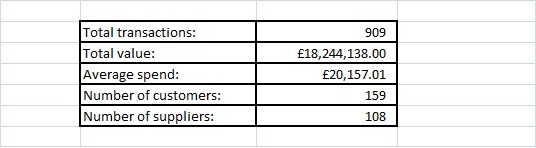
G-Cloud sales data is now made publicly available by the Cabinet Office as a spreadsheet, a great example of the transparency agenda within government. The current data covers all G-Cloud sales over the last 13 months. And that data are a probe of my opinion, (please let me mention that I’ve copied some pictures from Andy Powell’s post ):
 
13 months Summary: from 2012-03 until 2013-03:

UK Cloud Store-General Data
 
 
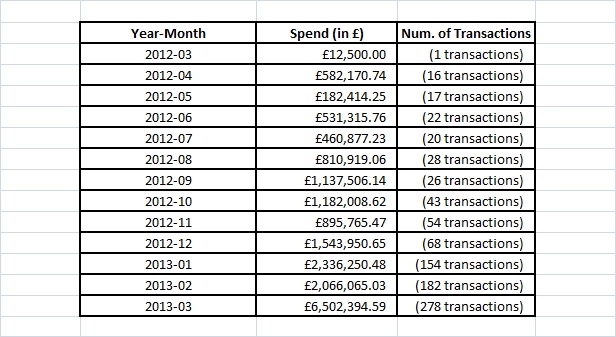
Total spend by month:
 
UK Cloud Store-Total spend by month

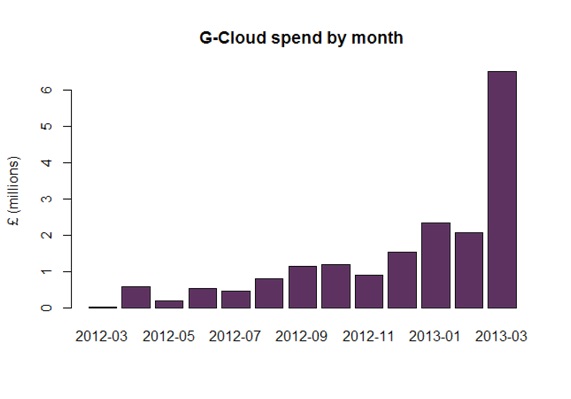
If we drawn this data, the picture shows a exponential growth curve with a sharp rise in sales during March this year, something that has been blogged about by various people:

UK Cloud Store-Spend by month graph


Besides the spent by lot has been the following:
UK Cloud Store-Total spend by lot

That clearly shows a bigger interest in Consulting Services.


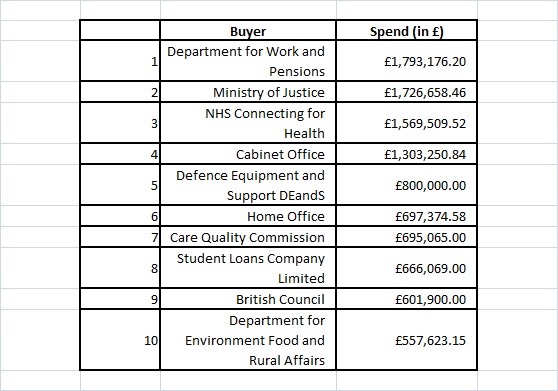
Moreover, relating to the most active agents, in one hand, the 10 top buyers (by spend) have been the next organisms:

UK Cloud Store-Top 10 customers by spend


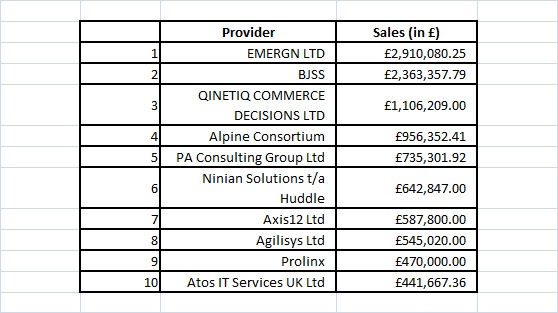
And, in the other hand, the 10 top providers (by sales) have been the next companies:
UK Cloud Store-Top 10 suppliers by sales

miércoles, 24 de abril de 2013

The New ECHO platform of Tissat for emergency and citizen security

The platform is mainly intended for providing an advanced infrastructure for Public Emergency Systems (as the European 112 phone number or the USD 911 and so on) but also appropriate for other kind of emergency or security services (as fire brigades, policy, health emergency,  and so forth). The new system incorporates from traditional tools, as identification of the exact place of the incident, as modern ones, as video transmission from the operating brigades or vehicles displaced to the incident place, and favours information exchange between the emergency and security services.
 
The new technological ECHO platform offers the most efficient management and coordination of all the services intervening in an emergency. The incorporates a georeferencing tool which allows operators to identify the exact location of the incident, wherever the person requesting an intervention may be located, and it speeds up the information interchange between emergency and security services. Moreover, the coordination between the organizations and agencies attending incidents is another of the main aspects which improves the platform; transferring real-time information automatically to the emergency and security services of the various Public Administrations in order to set up a suitable contingent to face the event.
 
In this way, the participation and coordination between the various organizations involved are reinforced, such as the Local Police, National Police, Civil Guard, Fire Brigades, Heath Emergency, and the Military Emergencies Units, in order to improve operations as much as possible.
 
In words of Carmen García, the Commercial Director of Tissat, “this platform offers a more agile, flexible tool to manage and follow-up tool the emergency, so the response time is shorter because data transfers become more agile from the time the call is made to when action commences”.
 
Tissat has translated its more than 15 year experience in maintaining and developing emergency solutions to the development of his system with the idea of “responding to new citizen requirements in this way by modernising and updating emergences management comprehensively in order to achieve better efficiency in rendering this public service”.
 
This system is also a partial result of the R&D “CERI” project developed by Tissat with the partial funding help of “AVANZA2” programme of the Spanish Government (via the “Ministerio de Industria, Energía y Turismo”) with the collaboration of European Union (FEDER).
 
This project is still under development, and new results are expected that will let TISSAT to add new features to the system in short , after the appropriate work of debugging, stabilizing, and “productizing” as well as other related tasks, that let us to convert the R&D results in a product/service.

jueves, 11 de abril de 2013

Cloud Movements (2nd part): Oracle’s fight against itself (and the OpenStack role)

In a last week post (I use, or try, to do one per week, but last week there were a couple, thanks to OpenStack Grizzly delivery) I analyzed last Cloud movements of traditional IT giants; specifically we speak about HP and IBM: both of them just embraced OpenStack (in short, “HP Cloud” was built on OpenStack and IBM announced that all of its cloud offerings would be built around OpenStack). And I promise to speak in a coming post (this one) about the complex and eclectic Oracle’s position about Cloud, that ranges from disdaining Cloud Computing (e.g. Larry Ellison called cloud computing “nonsense” in 2009), to the recent Nimbula acquisition (Nimbula is a company that makes private cloud technology).

My thesis about Oracle position is, I announced in the  previous post, that Oracle is fighting against itself: I mean, its traditional and profitable business model is challenged by the Cloud model, and it has been delaying its adoption as much as possible (may be too much?), as IBM did when its mainframes ran mission-critical applications on legacy databases, and a new (by then) generation of infrastructure vendors (DEC, HP, Sun, Microsoft and Oracle) challenged it and disrupted the old IBM model: it was conflicted about selling the lower-priced, lower-margin servers needed to run them. (Note: since this a continuation of a previous post, let me to follow the numeration of that analysis, and start at point three)

3) Oracle and its CEO Larry Ellison used to disdain Cloud Computing (e.g. he called cloud computing “nonsense” in 2009) and there was a god reason to don’t permit Amazon-style metered pricing for Oracle’s mainstream database and middleware: for example, according to prices of spring 2012, a traditional 11g database license then would cost $2.8 million, it would cost less than $9 per hour using Oracle’s mySQL on Amazon. However,  in spite of that, its unclear strategy have evolving over time: 
  1. Ellison founded NetSuite, one of the earliest SaaS players,
  2. last fall Oracle announced a new an Infrastructure as a Service cloud computing offering to,
  3. and a few days ago Oracle said that it has bought Nimbula that in 2012 joined OpenStack; therefore Oracle, that so far has not been a member of the OpenStack community, will eventually have an interaction with open-source OpenStack project. Nimbula is a provider of private cloud infrastructure management software. It’s also interesting that Nimbula was founded by Chris Pinkham, one of the people who created Amazon’s cloud and managed the development of Amazon’s Elastic Compute Cloud (EC2). Besides, Nimbula’s main product is “Nimbula Director”, which allows enterprises and service providers to build large-scale, fully functional infrastructure services from bare metal in a matter of hours, and isolates customers from the operational and hardware complexities associated with deploying a private, hybrid or public cloud. So, at least, by proxy Oracle will have a place set for it at the OpenStack table. They’ll look across at other enterprise giants, such as VMware, which also by proxy joined OpenStack when it acquired Nicira (or IBM, HP, Dell as already analyzed in the previous post). According to oracle “Nimbula’s product is complementary to Oracle, and is expected to be integrated with Oracle’s cloud offerings”.
  4. According to Oracle, much of this efforts around cloud computing have been in providing hardware and software to run private clouds, through engineered systems such as Exalogic, and by customizing its databases, applications and middleware to run in cloud configurations (you can see its offer here).
  5. However, in my opinion, contrary to Oracle’s claims, neither its Exadata database machine nor its database appliance is a cloud strategy, because both strategies base their pricing on peak capacity, not on elastic metering (and a typical application runs most of the time at only 40 percent of its peak capacity.
  6. The reason for that is that, although Oracle clearly has the technical wherewithal to compete with the new databases that are powering cloud-based applications (Web 2.0, big data applications and so on), however so far they’re conflicted about how to handle metered pricing in these environments: i.e. changing the resources, processes and values that underpin its business model in order to support metered pricing is immensely challenging because the transition to metered pricing would dramatically erode Oracle’s revenue and 45 percent of its operating profit margins (see George Gilbert’s post titled in Oracle has a cloud computing secret  from where I take most of my information and ideas about). That is why Oracle is resisting metered pricing that implies the Cloud model.
 
In conclusion, the traditional technology giants are under pressure from investors to maintain revenues, and so far license and maintenance revenue have been the main, while cloud revenue services has historically been seen as a depreciation of these revenues. However, according to Gartner, the fastest-growing segment within the IT market is cloud compute services, which is part of the cloud-based infrastructure as a service (IaaS) segment: cloud compute services were expected to grow 48.7 percent in 2012 to $5.0 billion, up from $3.4 billion in 2011. Therefore the big traditional IT players are realizing that cloud is the way of the future (and the present) and the only way to keep their revenues, as Amazon is continuously showing us.
 
Consequently, at the last, the traditional technology giants are finally moving away from legacy practices (namely, license and maintenance fees) to the Cloud. So, as derivate consequence, there’s been, and will continue to be, consolidation occurring in the market since this big companies will continue to pick up important cloud pieces out there to build out full and impressive cloud portfolio and offers.