Mostrando entradas con la etiqueta Personal Cloud. Mostrar todas las entradas

martes, 5 de marzo de 2013

Personal Cloud Services Comparison

Recently (on 12 February 2013) Gartner has published its “MarketScope for Enterprise File Synchronization and Sharing”. Quoting to Gartner, “Enterprise file synchronization and sharing (EFSS) offerings enable productivity and collaboration for mobile workers who use multiple devices, such as smartphones and media tablets, in addition to PCs. Organizations must deploy EFSS services to secure enterprise information assets. Failure to provide these capabilities will subject organizations to information leakage threats caused by users who move data through uncontrolled personal cloud services”.
 
When I read this article, I recognize the generalization (as the same Gartner states in its report) of the concept of “Personal Cloud” (going, and widening, from the personal needs to the workers and company needs: the EFSS, subject on which I come back in the future),  about what I spoke several times in this blog last year (e.g. ”Market Analysis of Personal Cloud Services”, “Personal Cloud, pending challenges”, “Discussion on Gartner Forecast about Personal Cloud”, or “StackSync“).
 
As the name of one of those post announces, I‘ve already made a short analysis of the market at the date of the study (may 2012) and even shorter review of some products available in that moment: Dropbox, Google Drive (it that date just appeared), Microsoft SkyDrive, iCloud of Apple, SugarSync, Box, Cubby, Cubby, Insync, Wuala, Syncplicity (now acquired by EMC) and OwnCloud.
 
So, by the end of that year (2012) I decided to go more deeply into that study and I gathered when possible more data to widen the study scope. It was quite difficult, in short, because the market is still immature, as I’ve already said in some old post. About the market, in general, I keep my main old conclusions and expand them with the following ones:
  1. The market is highly fragmented
  2. A lot of small suppliers
  3. Great dynamism
  4. Mergers, acquisitions and consolidation will become common, since some big players are still outside of the market right now.
  5. It’s quite difficult to compare prices because of:
    • Some provider limit the files size (even depending in the file type).
    • Other ones limit the number of transactions (or bill for them).
    • Other ones limit the downloading traffic (or bill for them).
    • Others limit the number of User’s devices to synchronize.
    • In general the billing policies are pretty disparate: from flat rate to billing for number of users, per space quota, per downloads, per a combination of two o more of them, and so on.
    • etc.
  6. Very different technologic performances, as well as continuous improvements (several at the year) make difficult to compare vendors or providers based on their current features:
    • Available clients and supported devices
    • Redundancy and number of copies of the stored information
    • Security in communication
    • Security in stored information
    • Laws and regulation (specially about privacy) accomplishment
    • Service and support are highly variable from provider to provider, so it isn’t almost impossible to compare them.

As just stated it is not easy to compare services but to be hones it’s still more difficult because in most the cases not all the needed information is publicly available in the web site of companies: so, if you aren’t Gartner, you have ask that information or to sign for a free trial (where the performances are not the same of the real services), and so on. In this way I must mention too, that it was helpful the work made by other people, since I found related reports with valuable information. So when I compare all the information I decided not publicize because there are a lot of blank cell: comparison is not possible. However, after reading the aforementioned Gartner report, where they left out a lot of important players (for good and explained reasons) as Dropbox, Apple (iCloud), Microsoft (SkyDrive) and Google (GDrive), ownCloud and others, I decided to publish my results because some of them are in my table.
 
Prior to show my comparison table, please let me see it again:
  1. When you see a blank cell in my comparison table just implies that I’VE NOT BE ABLE to get the information.
  2. And the comparison took me a couple of months (I do it in my free time) so I compare services at different dates.
  3. And it was finished in the first half of the last December (so these results today could, and probably will, be different)
  4. Frankly, I also must state that I use several reports that I found about this subject (introducing a wider time gap).
  5. Note: I’ve got the time and the Gartner permission; in future post I’ll summarize the Gartner’s “MarketScope for Enterprise File Synchronization and Sharing” report.
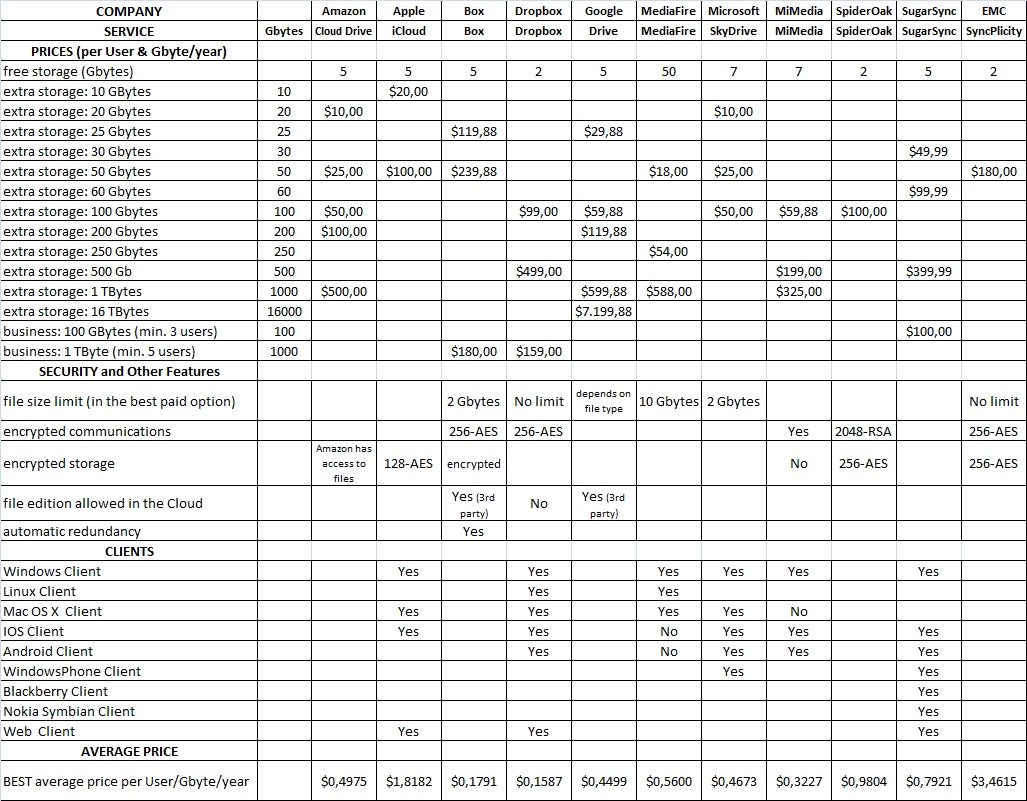
Next table summarizes my own comparison results:

Personal Cloud Services Comparison.large

lunes, 26 de marzo de 2012

Personal Cloud, pending challenges (Clouds Personales: desafíos pendientes)

(First of all, I beg pardon to Spanish readers: quiero excusarme de nuevo con quienes solo entiendan el español, lo siento pero de nuevo he caído en la comodidad de no traducir estas líneas extraídas de un proyecto de I+D en el que estoy colaborando).

A few day ago we advance a couple of challenges that Personal Clouds must solve in order to facilitate their massive adoption by users and companies. Focusing on that subject, the following ideas are an excerpt of the “state of the art” of an European R&D project (“CloudSpaces”) where we’re collaborating (leaded by Pedro García, teacher at University “Rovira i Virgili”).

In the next few years, users will require ubiquitous and massive network storage to handle their ever-growing digital lives. Every user will handle hundreds of gigabytes to store digital information including photos, videos, work documents and communication flows like emails or social communication.

To meet this demand, current trends show an increasing number of enterprises and users migrating their data to Cloud storage providers. A major selling point for Cloud computing is that it offers on-demand storage capacity that otherwise might not be affordable.

In this line, the Personal Cloud model is a user-centric solution to manage such massive amounts of digital information. Unlike application-centric models where data is tied to a specific application, user-centric models provide a personal storage service for user data.

The Personal Cloud model defines a ubiquitous storage facility enabling the unified and location agnostic access to information flows from any device and application. Commercial providers such as Dropbox, Box, SugarSync, or Ubuntu One are offering very popular Personal Cloud solutions that keep “in sync” the information from the different user devices. These solutions also permit information sharing with other users within the same Personal Cloud provider.

The popularity of these killer applications lies behind their easy-to-use Software as a Service (SaaS) storage facade to ubiquitous Infrastructure as a Service (IaaS) storage resources like Amazon S3 and others. In a recent report, Forrester research forecasts a market of $12 billion in the US in paid subscriptions to personal clouds by 2016. This growing popularity of Personal Clouds is also attracting the major players in the market, and Google (with the all but finished Google Drive), Microsoft (with SkyDrive) or Apple (with iCloud) are offering integrated solutions in this field.

But Personal Clouds are in their infancy, and two major problems must be solved to facilitate their massive adoption by users and companies:
  1. First, there is a big privacy problem that precludes the adoption of this model by many users, companies and public institutions. Most Personal Clouds follow a simple centralized synchronization model that stores all information in the Cloud as a remote file system. The entire data management process is in the hands of the Cloud providers, so the users really lose control of where their information is stored and who can access it. The problem is that traditional means of privacy preservation like the use of personal encryption keys is against the business model of many Personal Cloud providers. In October 2011, for instance, Forbes Magazine published that Dropbox has 50 million users, of which 96% are employing a free account, which illustrates that Dropbox is subsidized by a minority of users who pay to obtain more than the free 2 GBs of storage space. To compete for the market share, many Personal Cloud providers, including Dropbox and the likes, offer value-added services that require the provider to retain a copy of the decryption keys. Reconciliation of privacy preservation and revenue growth rates is a big issue in today’s Personal Cloud model.
  2. Another important problem is the lack of interoperability between Personal Cloud services impeding information sharing, but also precluding information portability among them. This generates what is known as vendor lock-in: a best decision now may leave a customer trapped with an obsolete provider later, simply because the cost to switch from one provider to another is prohibitively expensive. This may lead to a kind of data inertia where the more data given to one provider, the more difficult it becomes to move. A clear example of vendor lock-in in the Personal Cloud is folder sharing. To join a shared folder, users need to have an account in the same Cloud provider, inciting users to inadvertently get stuck with the chosen Cloud vendor. In addition to the costs of switching data, the adoption of an alternative solution will require to set up a new account for every user and install software clients on their devices. This sunk cost may represent a major barrier to entry for small to mid-size businesses that cannot afford the redundancy that an enterprise-class infrastructure would cost.
CloudSpaces project face up to both challenges and we hope its research activities bring new ideas and approaches to solve them, and let Tissat to improve StackSync service with even enhanced security features.

martes, 20 de marzo de 2012

Gartner predice que las Clouds Personales reemplazarán al PC en el 2014 (Personal Cloud to replace PC by 2014)

Me permito copiar y pegar un extracto sobre esta noticia (¿con un título “provocativo” para ganar nuestra atención?) de la pretigiosa firma Gartner. La noticia trata del advenimiento de las Personal Cloud tema que ya hemos tratado recientemente y que enlaza con trabajos que estamos realizando en Tissat dentro del proyecto “Real Cloud“, que en uno de sus objetivos persigue el desarrollo de StackSync, y de otro proyecto europeo (CloudSpaces) en el que también estamos colaborando. Tengo la intención de comentar este artículo de Garner con un poco más de detenimiento en los próximos días. He aquí un resumen de lo publicado en diversos medios al respecto:
The reign of the personal computer as the sole corporate access device is coming to a close, and by 2014, the Personal Cloud will replace the personal computer at the center of users’ digital lives, according to Gartner, Inc.


Gartner analysts said the personal cloud will begin a new era that will provide users with a new level of flexibility with the devices they use for daily activities, while leveraging the strengths of each device, ultimately enabling new levels of user satisfaction and productivity. However, it will require enterprises to fundamentally rethink how they deliver applications and services to users.


“Major trends in client computing have shifted the market away from a focus on personal computers to a broader device perspective that includes smartphones, tablets and other consumer devices,” said Steve Kleynhans, research vice president at Gartner. “Emerging cloud services will become the glue that connects the web of devices that users choose to access during the different aspects of their daily life.”


The past two years have been a whirlwind in the client computing space, leaving many enterprises asking what comes next and what the environment will look like in five years.

“Many call this era the post-PC era, but it isn’t really about being ‘after’ the PC, but rather about a new style of personal computing that frees individuals to use computing in fundamentally new ways to improve multiple aspects of their work and personal lives,” Mr. Kleynhans said.

Several driving forces are combining to create this new era. These megatrends have roots that extend back through the past decade but are aligning in a new way.


Megatrend No. 1: Consumerization — You Ain’t Seen Nothing Yet

Gartner has discussed the consumerization of IT for the better part of a decade, and has seen the impact of it across various aspects of the corporate IT world. However, much of this has simply been a precursor to the major wave that is starting to take hold across all aspects of information technology as several key factors come together:

  • Users are more technologically savvy and have very different expectations of technology.
  • The Internet and social media have empowered and emboldened users.
  • The rise of powerful, affordable mobile devices changes the equation for users.
  • Users have become innovators.
  • Through the democratization of technology, users of all types and status within organizations can now have similar technology available to them.

Megatrend No. 2: Virtualization — Changing How the Game Is Played

Virtualization has improved flexibility and increased the options for how IT organizations can implement client environments. Virtualization has, to some extent, freed applications from the peculiarities of individual devices, operating systems or even processor architectures. Virtualization provides a way to move the legacy of applications and processes developed in the PC era forward into the new emerging world. This provides low-power devices access to much-greater processing power, thus expanding their utility and increasing the reach of processor-intensive applications.


Megatrend No. 3: “App-ification” — From Applications to Apps

When the way that applications are designed, delivered and consumed by users changes, it has a dramatic impact on all other aspects of the market. These changes will have a profound impact on how applications are written and managed in corporate environments. They also raise the prospect of greater cross-platform portability as small user experience (UX) apps are used to adjust a server- or cloud-resident application to the unique characteristics of a specific device or scenario. One application can now be exposed in multiple ways and used in varying situations by the user.


Megatrend No. 4: The Ever-Available Self-Service Cloud

The advent of the cloud for servicing individual users opens a whole new level of opportunity. Every user can now have a scalable and nearly infinite set of resources available for whatever they need to do. The impacts for IT infrastructures are stunning, but when this is applied to the individual, there are some specific benefits that emerge. Users’ digital activities are far more self-directed than ever before. Users demand to make their own choices about applications, services and content, selecting from a nearly limitless collection on the Internet. This encourages a culture of self-service that users expect in all aspects of their digital experience. Users can now store their virtual workspace or digital personality online.


Megatrend No. 5: The Mobility Shift — Wherever and Whenever You Want

Today, mobile devices combined with the cloud can fulfill most computing tasks, and any tradeoffs are outweighed in the minds of the user by the convenience and flexibility provided by the mobile devices. The emergence of more-natural user interface experiences is making mobility practical. Touch- and gesture-based user experiences, coupled with speech and contextual awareness, are enabling rich interaction with devices and a much greater level of freedom. At any point in time, and depending on the scenario, any given device will take on the role of the user’s primary device — the one at the center of the user’s constellation of devices.


“The combination of these megatrends, coupled with advances in new enabling technologies, is ushering in the era of the personal cloud,” said Mr. Kleynhans. “In this new world, the specifics of devices will become less important for the organization to worry about. Users will use a collection of devices, with the PC remaining one of many options, but no one device will be the primary hub. Rather, the personal cloud will take on that role. Access to the cloud and the content stored or shared in the cloud will be managed and secured, rather than solely focusing on the device itself.”


Additional information is available in the Gartner report “The New PC Era: The Personal Cloud.” The report is available on Gartner’s website at http://www.gartner.com/resId=1890215.

viernes, 2 de marzo de 2012

StackSync, un ejemplo español de Personal Cloud

Ayer comentábamos el tema de las “Cloud Personales”, y citábamos un ejemplo de servicio SaaS que permite “sincronizar” la información que el usuario almacena en todos sus dispositivos: el PC del trabajo, el PC de casa, el iPAD, el móvil, etc. también comentábamos que los primeros  Proveedores de ese tipo de Servicios Cloud fueron empresas Dropbox o SugarSync, y que el éxito de los mismos ha provocado que los grandes del mercado hayan lanzado sus propios servicios (el iCloud de Apple, el SkyDrive de Microsoft) o lo vayan a hacer en breve (el Drive de Google).

También en España varias empresas se han lanzado al área de las “Personal Cloud”. Es interesante destacar la idea del “escritorio en la nube” o “cloud desktop” (que no hay que confundir con la "virtualización de escritorio" o "desktop virtualization", pese a las similitudes) de la empresa española Eye OS, o el propio servicio que Tissat va a lanzar en breve y al que de momento denominamos StackSync y cuyo prototipo se está desarrollando dentro del proyecto “RealCloud”, al que ya hemos aludido en días precedentes por lo que solo voy a recordar que está siendo financiado por el programa INNPACTO del anterior Ministerio de Ciencia e Innovación (y que está siendo desarrollado por un consorcio integrado por la Univ. Rovira i Virgili, la Univ. Jaume I, el I.T. AIMME, la empresa Corex, y TISSAT que, además, ejerce de líder del proyecto).

Adjunto un vídeo que muestra el funcionamamiento básico de este Servicio:

jueves, 1 de marzo de 2012

“Personal Cloud”, ¿un nuevo modelo de despliegue de Cloud Computing (junto a los de Publica, Privada, Comunitaria e Híbrida)?

La idea surge de la cada día más creciente necesidad de espacio y aplicaciones que un ciudadano tiene para poder gestionar sus “vida digital” (fotos, videos, documentos de trabajo que precisa llevar encima o tener en casa, datos asociados a flujos de comunicaciones como e-mail, redes sociales, etc.) y de soluciones que Proveedores de Servicios Cloud están ofreciendo para resolver en parte ese problema (por ejemplo: Dropbox, SugarSync o Ubuntu One) permitiendo que el usuario pueda “sincronizar” la información (toda o la parte que él decida) que almacena en todos sus dispositivos: el PC del trabajo, el PC de casa, el iPAD, el móvil, etc. Algunas de estas soluciones también permiten compartir la información con otros usuarios que usen el mismo servicio.

La diferencia distintiva de los servicios del tipo “Personal Cloud” es que están centrados en el usuario (user-centric) a diferencia de los modelos precedentes que estaban centrados en la aplicación (appplication-centric) ya que los datos estaban vinculados a la aplicación. Además, el ámbito de la nube, es en principio, la de todos los dispositivos del usuario que él decida integrar en su Cloud Personal y, además, una copia de la misma que existe en la nube (en principio codificada para que solo el usuario pueda tener acceso a ella) con la ventajas que ello aporta, tener una copia de seguridad en la nube, o en caso de necesidad (por no tener ninguno de nuestros dispositivos a mano) poder acceder desde otro ajeno (con las medidas de seguridad adecuadas), además ello también posibilita compartir parte de dicha información con amigos, e incluso el trabajo colaborativo.

En consecuencia el modelo de Cloud Personal define, en principio, un servicio de almacenamiento ubicuo y al que no le importa desde donde se accede a la misma (como se dice actualmente, es agnóstico del dispositivo de acceso y de la localización del mismo), y la información fluye en todos los sentidos entre los dispositivos que integran la Cloud Personal.

Muchos de los servicios existentes están siendo provistos por relativamente pequeñas empresas (como las antes mencionadas DropoBox, SugarSync, etc.) que, en muchos casos, han montado su oferta sobre los servicios S3 de Amazon (o de proveedores IaaS similares), y deben su éxito tanto al nicho de mercado que ha descubierto, como al haber combinado hábilmente las facilidades de uso de un Servicio tipo SaaS, con las necesidades de infraestructuras de almacenamiento de tipo IaaS que quedan totalmente recubiertas (y ocultas) para el usuario por la capa de servicio recibido, de forma que el usuario solo ve un amigable, sencillo y cómodo servicio SaaS.

Por otra parte, la creciente popularidad de las Cloud Personal ha hecho que los grandes del mercado lancen sus propios servicios al respecto (por ejemplo, el iCloud de Apple, el SkyDrive de Microsoft, o el inminente drive de Google) y que las mismas se integren (o estén camino de ello) con el resto de su catálogo de servicios del tipo web 2.0 (redes sociales, blogs, etc.), circunstancias que en mi opinión producirá, por una parte, transformaciones adicionales en los mismos, y por otra parte completará la definición de Personal Cloud que dimos al inicio de este comentario, y en la que pretendimos aclarar que los servicios de Cloud Personal no solo conciernen al almacenamiento de datos personales (su razón de origen), sino también a las aplicaciones personales del usuario.