Mostrando entradas con la etiqueta FASyS. Mostrar todas las entradas

lunes, 16 de julio de 2012

Personal Health Data Management in the FASyS project

Reviewing the series of posts that I dedicated to FASyS project, I just discovered that I forgot an important FASyS aspect (where Tissat is also involved): the personal health data management.
As stated in a previous post, the EHR (Electronic Healthcare Record) stores the medical data of the patient from the point of view of the assistance process, and it is owned by the current healthcare system. With the purpose of improving the characterization of the person and his environment, EHR data have been increased. This new amount of information is stored, together with the EHR information, in other repositories. These repositories are known as PHR (Personal Health Record) and can collect data such as habits, preferences, information about the family, moods, customs or nutritional profile. A PHR adapted to the needs of FASyS requirements is being developed.
This kind of repositories is owned by the person, who has the option to share it with people he chooses: when an employee goes to work in a factory for the first time, health professionals ask him to download his previous EHR, in order to have the personal file (PHR) more complete for the final diagnosis. PHR developed by FASyS is based on the following aspects:
  • It is focused on workplace health.
  • It allows patient to introduce data (automatically or manually)
  • It allows an exchange of information with the healthcare system (EHR)
  • It includes an option to generate summaries to share information with others PHR. One of the advantages, for example, is when a worker goes to work in other factory. If the new factory has the FASyS system, his PHR could be downloaded in the system of the new factory in order to have a more complete file.
  • Stored Data can also be extracted for consultations in case health professionals need to do. Consequently, there must be an Access Control. With this control, it is ensured that these personal data can only be seen by authorized people. If the data have to be used for statistical studies, it must be made anonymous. So, the results of the studies will not be related to people in particular.

Therefore, PHR (Personal Health Record) of the patient that is mainly compound of:
  • The health data gathered by medical body sensors that the worker wears: part of FASyS system.
  • The environmental data gathered by FASyS on-premises sensors: part of FASyS system.
  • The EHR (Electronic Health Record) i.e. official health state of the worker (as patient) with data as diseases, surgically interventions or pain that were diagnosed by private o public Health Institution (Hospital, Medicine Dr., and so forth): external information but integrated in the FASyS system.
  • The historic of data and events related to the worker/patient collected by the FASyS system.

martes, 3 de julio de 2012

“Workflows and Choreographer” in the FASYS project.

As it was explained in previous posts, a “Health Continuous Vigilance System” is been developed inside the FASyS Project. It provides a workable solution in order to improve the current healthcare system in the factories of machining, handling and assembly operations. With such system, it’s possible to obtain a more continuous monitoring of the worker, improving his own health and making the factory safer and healthier, by increasing the number of variables obtained from the environment of the worker, from personal parameters, and by combining them with the medical knowledge and the actuation protocols.

One of the main modules of this Health Continuous Vigilance System is the Response Medical Center (RMC) where the main tool is the NOMHAD application whose first version that is all but finished (not including environmental data). Once the information has been monitored and classified, the next point is focused on the intervention. With the aim of representing prevention protocols for this intervention, workflows are developed. Given the workers singularity, the adaptation of the prevention protocols is needed for each one of them. In this way, the elimination of the occupational hazard is much more effective.

In order to illustrate graphically the action to perform and the standards describing the flow followed by actions, it is possible to use Workflows. They are a formalization of the process to be automated. Some “workflow languages” can be executed automatically. This is known as a workflow interpretation. The automatic interpretation of a workflow is done by a “workflow engine”, which can complete the actions explained in a workflow, in the order and with the derivation rules specified in it. Workflows can be employed by people who are not experts in programming for the health area. For that reason and thanks to these modules, health professionals are able to design and modify the protocols to be executed automatically. And that’s the reason of the importance of Workflows in the FASyS Project. In order to give support to this important piece a lot of already existent workflow languages and workflow engines has been studied and tested, but we finally decide built the ours: TPA and TPA-engine.

Coming back to the process of gathering information about the worker (either personal parameter or environmental data) it should be noted that it’s necessary to interconnect sensors and services in a fault tolerance and decentralized way. This process, complex and highly interconnected, can be solved using a “Choreography of Services”. This means that the “choreographied” processes are independent and can communicate each other to define execution flows. This model makes easier the connection and disconnection of services dynamically, and at the same time it is capable of using different kind of sensors and configurations. This approach is shown in next figure:

FASyS Architecture

The use of “choreography” to interconnect services requires also the use of a common exchange language to allow the services to understand each other. This can be performed by an architecture which includes a Semantic layer in the Choreographer. The reason to do that is to improve the intercommunication among sensors, actuators and services of the system. From the programmer’s view, “choreography”·is similar to SOA but with some important differences: services are not discovered but known from a defined list, besides the code is quite light (thought for devices with very small computing performances), and so on.

The ontologies are a solution to describe concepts formally. Concretely, an ontology is a formal and explicit specification of a shared conceptualization. It provides a common vocabulary that can be used to model the kind of objects and/or concepts and its properties and relations. The “Ontologies Reasoners” are software applications allowing the semantic seek in the ontologic description. Using this technology, it is possible to describe semantically the sensors and data services, giving them the ability of having a more complete understanding of the collected data and the services actions.

The use of services of Ontologies and Reasoning Systems to describe the data coming from the sensors, makes possible to get a more precise interpretation and to detect automatically the sensors and services available at any time.

Finally, referring to figure, a “Services Orchestrator” is also included in the architecture and moreover. “Orchestrator” is an automata engine that is connected to the Choreographer which accepts the use of Workflows relating different services linked by the “Choreographer”.

Although is not shown in the above figure, a “Process Mining” module has also been added. The main objective of this Process Mining Module is to build, from all the events data gathered about a worker, the real process followed during an activity (this process could be either the consequence of a workflow assigned by medical professional or the one in working with dangerous machine. In such way the current process can be compared against, depending on the case, the one established by the medical staff or the one he use to do. Therefore, we can detect either the break of medical workflow, or an anomalous conduct in worker habits that could be the visible effect of an internal (physical or psychological) problem.

miércoles, 27 de junio de 2012

FASYS project once again: the Health Continuous Vigilance System

After introducing the FASyS project, and briefing the NOMHAD Application, today we are going to treat the “Health Continuous Vigilance System” itself:

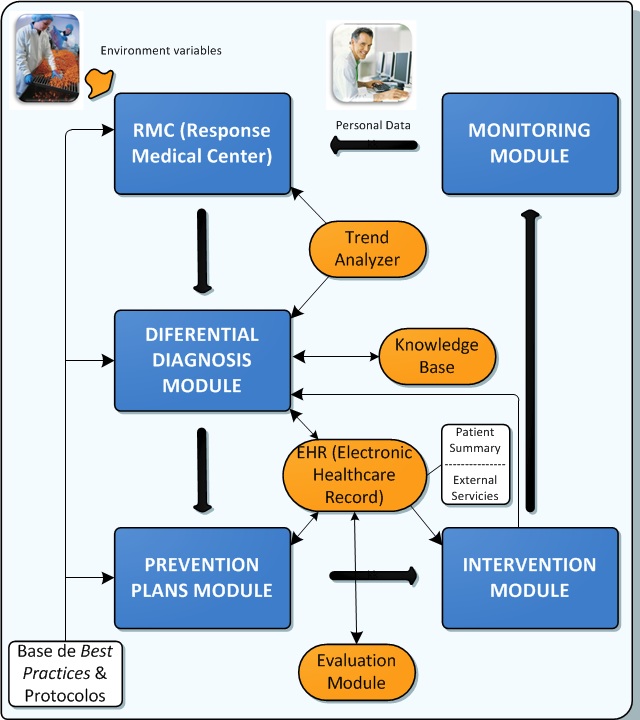
Next figure presents the architecture for the “Health Continuous Vigilance System” developed inside the FASyS project. This system is based on five main parts: Monitoring Module; Response Medical Center; Differential Diagnosis Module; Prevention Plans Module; and Intervention Module. Each of these parts can be influenced by a number of external variables and parameters such as the Electronic Healthcare Record (EHR).
Health Continuous Vigilance System

Given the big amount of generated information in this model, it is necessary to process all the collected data, since such amount of information would not be easily understandable by health professionals. Services and intelligent devices that have been generated will provide a classification of the monitored data. Some data will be set inside a normal range, and others will be out of the settled limits, generating alarms due to this. Furthermore, this classification will help the doctor to organize and evaluate all workers’ data and at the same time it will be able to act more precisely against a particular diagnostic.

Therefore, the Monitoring Module is where is stored all the personal information gathered by the system about the worker himself. All these personal data, obtained from the monitoring, are complemented and improved by variables from several sensors in the factory (collecting temperature or humidity, that is, particular characteristics from the workplaces at which the worker can stay during a work journey), that are joined all together in the Response Medical Center (RMC). The RMC allows to filter and organize the population depending on the changeable rules and on the user role. So, it is in this module where the first amount of data is collected, creating, as a result, personalized records of the workers and establishing alerts which make easier the task of health professionals.

The information stored in the previous module is not enough to make a complete diagnosis. So, data from other sources are needed, such as:
  • Data from a medical base of knowledge (it contains relations among diseases, risks, medical tests, medical recommendations, etc).
  • Personal data from the health system, which include the previous medical history and it is known as Electronic Healthcare Record (EHR).
  • Trend analyzer data. This system is in charge of detecting how some parameters of a person are changing during the pass of time. These parameters can be added to the absolute values in order to get a more complete evaluation of the person.
  • Evaluation module results. It can be defined as a “photograph of the person” in a particular moment, with no need to detect a problem.
These four mentioned sources are the subsystems which provide important information to the main blocks. To manage all this information, a Differential Diagnosis Module has been developed (Dr. House influence gets far). This module, through intelligent systems, helps in making decision to health professionals.

The next step is to reach the Prevention Plans Module, where it is defined how to act. The plans to be taken can be of two types: in one hand a medical diagnosis and in the other hand a technical diagnosis, for instance a redesign of the workplace. It is important to remark that these actions are not exclusive. According to this, different levels of action can be established; that is, from very complex levels to more simple levels such as, for example, reminder panels. In addition, the prevention actions carried out in this module can be conducted at three level:
  • At the first level, the system reacts automatically. When one of the collected data reaches a condition that the professional wants to be controlled, there is an automatic reaction. This associated reaction can be the activation of an alarm, a protocol in a situation of risk, etc. These automatic reactions are achieved using ECA rules (i.e. Event-Condition-Action rules).
  • At the second level, health professionals receive the alerts and then they react in consequence, acting on individual workers. The reaction of professionals can be the assignation of a prevention plan developed before, or the assignation of a prevention plan modified for the worker situation in particular. These ways that define the processes are called workflows. (Note: these workflows will be treated in a more detailed way in next posts).
  • The third level is in charge of providing knowledge for the other two levels, improving the protocols, adapting them to new situations and personalizing the recommendations. Innovative intelligent tools are used to manage it.
Finally, the Intervention Module is responsible for performing the particular actuation selected for the problem in question.

How it can be seen in the above figure, the “Health Continuous Vigilance System” is cyclic and works in a continuous fed-back learning way, therefore, after the Intervention Module, it starts again from the Monitoring Module.

Another important aspect to take into account is the personal data privacy. As a consequence of this, only a few people will have access to the EHR (Electronic Healthcare Record), to the personal variables, and to the personal diagnosis.

Finally, to complete a previous post, it should be emphasized that NOMHAD application is used in the Response Medical Center Module; in fact it is the main tool of this module.

A next post will be dedicated to complete the vision of Tissat collaboration on FASyS Project, and we’ll focus on workflows used for prevention protocol implementation, as well as in the use of a “choreographer” to interconnect services, and in the management of PHR (Personal Health Record).

jueves, 21 de junio de 2012

FASYS project revisited: the NOMHAD Application

A few days ago we did a brief introduction to FASyS project, Spanish acronym for “Absolutely Safe and Healthy Factory” and, as its name states, it’s an European R&D initiative for improving industrial workers security. Today we are to focus on some aspect of this project, especially on the objectives where Tissat is involved:

Several European statistics confirm that a large number of people have fatal accidents every year in the workplace. For this reason, one of the most important European objectives is to reduce the number of industrial accidents significantly. In fact, one of the European objectives set for 2020 is the 25% reduction in the number of industrial accidents. In order to reduce accidents it is essential to pay attention to the workers, their single workplaces and to their working conditions. In this way, if workers had a safer environment, the number of accidents could be significantly reduced, implying therefore a reduction in costs. Fasys Project, focused on factories of machining and assembly operations, aims to achieve this reduction promoting the use of technologies and giving, at the same time, a principal role to the worker. From now on, the worker, who has represented a neglected element in the factories, will be the center of attention. The increase of his security, and the enhancement of his working conditions and health, will be key elements for the Factory of the Future performance.
For this reason, the future work has to be oriented on new technological applications to get a factory safer and to reduce significantly the number of accidents. To control the accidents it is necessary to anticipate and estimate what can happen. So, prevention is a key point. To manage it, it is important to collect and measure data during a period of time, in order to evaluate their progress. Consequently, the perfect model would be a factory in which the risks and health were controlled at any time. To achieve so, FASyS has different main objectives and one of them (where Tissat is working actively) is to develop a “Health Continuous Vigilance System”. The system includes both the monitoring to characterize workers activity and environment, and aspects related to prevention protocols. To manage it, several systems of collecting data are needed. They can be distributed around the factory and monitor, for example, personal and environment data, or get information, for example, from medical knowledge or previous medical information of the worker. Besides, due to the big amount of generated information (so far a “big data” problem is not reached on the prototype, but it’ll probably appear when moved to more complex environments), intelligent systems for massive data processing are needed. In this way, the information could be easily managed and classified, in order to obtain data from a specific situation that could be required.
Nowadays, the number of sensors for monitoring personal health data is increasing. In addition, sensors that collect environmental parameters in industrial factories are being introduced more and more. The problem encountered so far, and solved in this project, is that these data are not connected. The information is only collected in order to produce isolated diagnosis, but not common results, and the collected data become less relevant if they are not treated together. The final decision, in a dynamic environment like a factory, could be more precise if results came from a study of a diverse set of parameters.

According to FASyS project, the first step to improve the health and safety in factories is to increase the personal and environmental monitored data. Consequently, there is a need to develop a system able to store all this information. So NOMHAD system has been developed.
NOMHAD System

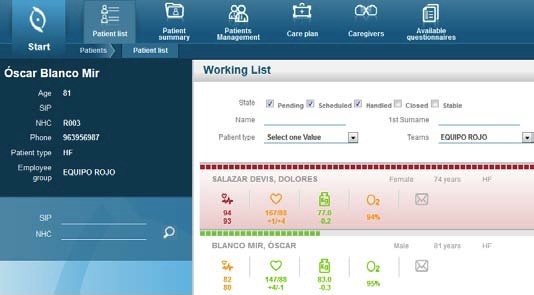
NOMAHD is an application able to stored part of this required information: workers’ personal parameters such as blood pressure, pulse and oxygen saturation. The system performs a prioritization and an intelligent management of alarms. These alarms are based on the rules and protocols accepted by health professionals and by the health system. This service will combine the information, through the prioritized alarm list, with the generation of specific summaries about the state and evolution of the person. This enables a more efficient management of events.

So far, the options managed by NOMHAD are specifically thefollowing:
  • To create a patient. The professional will fill the administrative worker data and the medical relevant data for a future evaluation. Patients will also be assigned to health professionals.
  • Reception and Display of Monitoring. The system stores the monitoring data of the person. It stores them into a database related to the personal health record in order to be used by health professionals in the future. The monitoring data are displayed in the right way, either in graphical form, numerical, image, etc. The data stored in the system are processed on arrival. A set of several rules, defined by the doctor and adapted to the personal profile, are applied. These rules allow the system to detect potential anomalies found in the data, in order to take decisions. For the definition of the rules, health professionals will have a tool to help themselves with this task.
  • To configure alerts. The system will have an alert module that, based on the monitoring data and the limits defined as optimal by a professional, will be able to detect whether the data stored are acceptable or not.
  • The possibility of assigning questionnaires. The patient mood could be extracted from these questionnaires. Health professional will choose the questionnaire and will have the possibility to personalize it depending on the needs of each worker in particular. These questionnaires will be available in the future in case the professionals want a subsequent consulting or validations.
  • Monitoring. The measurements can be obtained with usual external devices, whose information is introduced afterwards in the system or it can be used integrated elements into the system (controlled, for example, by Bluetooth and transmitting the captured data directly to the system). The design of the system can be extended to introduce new devices.
With the purpose of completing the personal data stored in NOMHAD, FASyS project proposes a connection to the current health system. This connection provides a register about the health state of the person during his lifetime, which collects data such as his diseases, surgically interventions or pains. This health system is commonly known as EHR (Electronic Health Record).
Finally, once the information has been monitored and classified, the next point is focused on the intervention. With the aim of representing prevention protocols for this intervention, workflows are developed. Given the workers singularity, the adaptation of the prevention protocols is needed for each one of them. In this way, the elimination of the occupational hazard is much more effective.
Next day we’ll focus on the architecture of the “Health Continuous Vigilance System”, as well as on the prevention protocol workflows implementation.

viernes, 15 de junio de 2012

FASyS Project: an European R&D initiative to improve industrial workers security

Now that the FASyS Project is in its last phase and an important milestone, the prototype testing in a living lab (a real factory), is going to be started, I remind that I’ve not written about. So, “its time has come”:

FASyS is the Spanish acronym for “Fábrica Absolutamentte Segura y Saludable”, that means “Absolutely Safe and Healthy Factory”. It’s a project with 40 month duration and a budget of 23.3 M€. It is one of the 18 large Spanish strategic projects supported by the CDTI (Centre for the Development of Industrial Technology) as part of the CENIT 2009 Programme.

With the ambitious goal of improving business competitiveness through new levels of industrial safety and workplace comfort, the FASyS project aims at implementing both the excellence model for integrated occupational health and safety management in the handling, machining and assembly industries, together with a new generation of safety technologies and solutions.
The FASyS project raises the definition of an absolutely safe and healthy factory, and it is structured into 8 sub-projects that are governed by a parallel temporal sequence, in which the maturity of diverse technologies and solutions increases and evolves through the achievement of individual phases:
  • SP1 – Scenario, Requirements and Model
SP1 establish the common framework for the entire project FASyS. At SP1, the reference model factory FASyS is defined, and also the scenarios where this model will operate and the architecture that includes the supporting technologies of the implementation of this model.
The FASyS model proposes a new approach in the design, implementation, operation and maintenance of a handling and assembly factory. Facing the traditional models that focus these phases on productivity paradigms to introduce then the health and safety needs of employees, FASyS will define a new model of Sustainable Factory where the employee, his safety, health and welfare ware the central axis in the factory model.

  • SP2 – Regulations, Legal, Ethical and Social Aspects
SP2 provides the regulatory, ethical and social frameworks that contextualize the development of technologies. Since the FASyS project aims from a highly monitored scenario, it is important not to forget the ethical and social constraints which also establish a development framework for other technologies in the project. In addition, SP2 develops new business models, thus allowing new players in the system.
FASyS will provide a range of technologies and services that enable a broader vision and rich in the development of security solutions and industrial health.

  • SP3 – Sensors and Communications
SP3 is focused on providing communications technologies and the development of (bio)-sensors that will support characterization, monitoring and action services in the context of personalized prevention of FASYS strategies, in order to control not only vital sings of the employees, but as well the conditions of the workstation, including the involved machinery.
SP3 will develop a robust architecture of scalable communication; a development platform for monitoring applications on sensor networks, and it will establish efficient mechanisms for locating objects and people.

  • SP4 – Diagnostic Systems and Health Surveillance
SP4 is responsible for the development of new actuation protocols and technologies for the deployment of new personalized systems of diagnostic and continuous health surveillance. To be able of establish and maintain the better health of the employees, it is necessary to process and work with a large amount of data obtained from evaluations, monitoring, censored data, etc. data about the workstation and environment, and data related to the employee’s work profile and background (work, personal, family, health,…), and the medical history, among others.

  • SP5 – Risk Detection and Evaluation Techniques
SP5 is intended to define and design the ergonomic, psychosocial and the workplace hygiene risks prevention protocols, and the intelligent mechanisms which will allow the detection of these risks. These new protocols will be supported by a technological platform which will allow a fast and easy deployment of totally contextualized interventions to the worker conditions, the work place and the task to perform.
These contextualized interventions require a high degree of intelligence, for which this SP will focus not only in the definition of the intervention protocols, but also in the development of the semantic description of the context in which they’ll be applied.

  • SP6 – Safe Manufacturing Equipment and Processes
SP6 aims at the development of certain capacities related to machine tools which would allow the development of intelligent work safety, well-being and comfort applications and devices. SP6 bases on the need to produce a machine evolution towards an active and cooperative element within the prevention strategies, with the capability to modify its own behaviour to adapt to the environmental and user needs and work in cooperation in an intelligent manner to avoid disasters.
The elimination of risks is foreseen from the machine design. The management of this intelligence and its integration in the global framework of the system are equally parts of the activities of this SP.

  • SP7 – Risk Control Platform
SP7 provides those elements necessary to offer intelligence to the environment through the general decision-making from all the information sources generated in all the other FASyS subprojects aiming to control and act over the health and the labour risks linked to the developed tasks while they’re being identified.
The final goal of SP7 is to provide the responsible of work safety with an interface which allows him to establish the most effective means to manage and prevent the existing risks so that those lead the environmental adaptation to the detected situations.

  • SP8 – Management and Evaluation Integrated Systems
SP8 has the final goal of designing and defining all those tests which will allow the validation of the proper functionality of the technologies to develop in order to reach the concept of FASyS factory. The new optimized manufacturing processes (work place operations, interrelations, etc…) will be defined and implemented inside the FASyS model, and with the results of the tests and through the user experience obtained by living labs means, the safety and prevention systems evolution plan from the actual model towards the FASyS model will be defined.


This 8 sub-projects has been split in a huge of tasks that are been implemented in 3 phases:
  • Phase I (2009-2010 Year) Specification of the FASyS Model and associated subsystems. Ensure the viability of Technologies at subsystem level.
  • Phase II (2011 Year) Develop mechanisms to ensure proper and easy integration and interoperability of all FASyS subsystems and technologies.
  • Phase III (2012 year) Ensure interoperability and optimization in system operation.
Normal delays on the project evolution produces we are lightly behind schedule and the current forecast is to finish on February 2013.

More information about the project can be achieved in http://www.fasys.es/en/ and we’ll speak again about in next comments, focusing on the Tissat role in this project.