Mostrando entradas con la etiqueta Walhalla. Mostrar todas las entradas

domingo, 26 de enero de 2014

Virtualization vs. Cloud Computing (III): business differences, plus other technical ones, and conclusions

Once again let me start reminding that this post is referred to the scope and context defined in my first post of this series (titled “Virtualization vs Cloud Computing (I): what are we going to compare?”), although at the end of this post we’ll widen it.
 
Besides, as summary, in the two previous posts we concluded:
  • Virtualization is an enabling technology for Cloud Computing, one of the building blocks used “generally” for building Cloud Computing solution (“generally” but not always, because nowadays Cloud is starting to use other technologies away from pure virtualized environments to offer  “Baremetal as a Services” …)
  • The services provided by “Cloud Computing Management Environment” and by a “Virtualization Management Environment” ARE QUITE DIFFERENT IN HOW THE SERVICES ARE PROVIDED: both the self service characteristic and location independence feature (in the sense of no location knowledge) are the main difference, but in some cases (depending on the platform) also massive scale out.
 
Going to the subject, another technological point of comparison is that Virtualization Management Environment (at the present almost none) does not offer to the user the knowledge in real time of how long it has been using the VM and other metrics of the service (“measured services” is a essential characteristic), or maybe the user can get that knowledge but not in a friendly way. The main reason for that is the different business model they were “initially” thought of:
  • Virtualization was born to take advantage of unused resources in a physical machine, solving several problems that appeared in scale-out servers: different physical characteristics for different cluster subsets (after one or more expansions), coarse granularity in the resource assignment that led to unused resources, security issues when applications from competing companies were run on the same physical machine. However, although virtualization allows to take advantage of unused resources in a secure way, in the practice it let to traditional DataCenter Service provider to pass (or add) from a (physical) “Hosting” business model to a “Virtual Hosting” model with lower prices, but the billing model was the same: in general the customer is billed in the same way as for physical hosting: a monthly fixed rate where the cost is proportional to the power (performances) of VM and the associated resources it has contracted, but disregarding of the real usage (the user does) of the virtual machine.
  • Cloud Computing was born to “allow” a real pay-per-use model. For this reason it’s as important the self-serving feature as the capability to turn on or off the VM whenever the customer wants, because (s)he doesn’t pay for the standstill period. About this subject, please note that the technological Cloud Computing concept only defines that the services must be metered (and that information must be continuously available for the customer), what allows the provider to bill for the real usage, but it’s not mandatory to do it.
  • Of course, both business models mentioned above were the two extremes of a broad market and represent the “pure” business models, but today there are several intermediate hybrid business models: for example, cloud computing environment based model that offer discounts if you contract for long fixed period or that offer lower price-per-hour if you pay a monthly fee (one of the Amazon options) or pure technological Virtualization Management Environment that offer pay-per-use business model, and so on. AMAZON (the great Cloud innovator) is a good example of that: for example, “Reserved Instances” give you the option to make a low, one-time payment for each instance you want to reserve and in turn receive a significant discount on the hourly charge for that instance (there are three Reserved Instance types: Light, Medium, and Heavy Utilization Reserved Instances, that enable you to balance the amount you pay upfront with your effective hourly price), the also offer volume discounts or “Spot Instances”, and so on.
 
Finally, concerning to the comparison points in the initial (reduced) scope defined, new customers needs are emerging to deploy applications on your physical servers, as well as your virtual servers, but keeping all the cloud model advantages (and essential characteristics): that’s the case, for example, when your application requires physical servers, or your production environment is too performance sensitive to run in VMs. Actually you don’t need to have a virtualized environment to be considered a cloud environment: your “virtual” instance might be a “container” which is not virtualized but running on bare metal (just sharing it with other containers) or even running directly and using completely the bare metal: “containers”, as aforesaid, are considered by some authors as sort of virtualization; so let me present an example of the latter case: OpenStack is currently developing the new “Iron” module that it’ll provide “Baremetal as-a-Service”, so  it’ll be possible to use the same API and the same pipeline to build, test, and deploy applications on both virtual and physical machines. Therefore, cloud technology is starting to use other technologies away from pure paravirtualized environments.
 
We initially limited the scope of this comparison to “compute as a resource”, but if we slightly widen that context to include (as usual) any computing related resources, i.e, storage, and communications resources, then new differences arise (depending on the solution that was used for building both the Cloud Management Environment and the Virtualization Management Environment):
  • Most (but not all) of Virtualization Management Environments offer only compute and block storage services, but usually they do not offer Object Storage as a Service; besides they use to offer “Storage Virtualization” (SV, i.e. capacity is separated from specific storage hardware resources) but don’t offer “Software Defined Storage” (SDS), that differs from the former (SV) because in the SDS not only capacity but also services are separated from the storage hardware.
  • Moreover, and almost none of them (Virtualization Management Environments) offers communications management as a Services. I mean not only virtual networks, but also main communications devices provided as a service: router, firewallls, load balancers and so on. Moreover, the “Software Defined Networking” (SDN) it’s a technology that, as far as I now, is been currently used only in Cloud Computing Environments where this kind of services are starting to be offered. Of course, some Virtualization Environments offer this kind of communication services, but not in a self-service way and where you can self-define your internal communications layout and structure, and so on, e.g. as shown in the next picture (taken from the topology designed by a customer using the TISSAT’s Cloud Platform mounted on OpenStack):
TISSAT's IaaS Cloud Platform
TISSAT’s IaaS Cloud Platform
 
 
At the end of this 3 post series, as summary, three conclusions:
  1. The technological concepts (virtualization and cloud computing) should not be confused with the pure business models they were initially intended for: virtual hosting (a fixed monthly rate lower that physical hosting) and pay-per-use (that some person call the Cloud Computing business model), respectively. And don’t forgot that at the present there are a lot of mixed business models disregarding the underlying technology.
  2. Both virtualization and cloud computing allow you to do more with the hardware you have by maximizing the utilization of your computing resources (and therefore, if you are contracting the service you can expect lower expenses). However, although currently there is an inevitable connection between them, since the former (virtualization) is “generally” used to implement the latter (cloud), this connection could be broken soon with the arising of new technologies and innovations, and they are not exactly the same: BOTH ARE QUITE DIFFERENT IN HOW THE SERVICES ARE PROVIDED (self service feature, no location knowledge, massive scale out, even metered service in some cases) and there are some technical differences between them. Additionally, depending on user’s needs one of them could be better or not: a lot of customers have enough with server virtualization, and it could even be the best solution for their needs; but in other cases cloud is the best solution for the customer’s needs, and no virtualization.
  3. Although still circumscribed to IaaS (i.e. forgetting PaaS and Saas), when we widen the comparison scope to include (as usual) any computing related resources, (not only compute but also storage and communications resources), then new differences arise since, for example, communications related Services (routing, firewalls, load balancing, etc.) are seldom (or never) offered as a Service in Virtualized Management Environments (in a self-service way and where you can self-define your internal communications layout and structure, and so on, taking advantage of Software Defined Networking technology). Besides, another main difference is how the Storage as a Service is provided: in a Virtualization Environment use to be reduced to Block Storage, no including Object Storage (as Cloud Environments do), and provided as Storage Virtualization but not as Software Defined Storage.

Note: Please, let me add that  Tissat (the company I’m working for) is offering all this sort of real IaaS Cloud Services as well more traditional DataCenter services (such as housing, hosting, virtualized hosting, DRP, and so on) based on its Data Centers Federation (that includes Walhalla, a DC certified as Tier IV by The Uptime Institute)  and using different product and solutions (currently VmWare, OpenStack, and so on) and most of the ideas of this post series are extracted from that experience.

jueves, 16 de enero de 2014

Virtualization vs. Cloud Computing (II): more technological differences

First of all, it is quite important to remember that this post is referred to the scope and context defined in my last post (titled “Virtualization vs Cloud Computing (I): what are we going to compare?”), where I defined Virtualization and Cloud Computing concepts used for this comparison; those definition could be others, of course, but then the conclusions will be others too, so due to its importance let me summarize them in the following points (if you need a more detailed explanation, please read my previous post):
  • By “Virtualization” we are going to refer ONLY to the “Hardware virtualization”, i.e. the creation of a virtual machine (VM) that acts like a real computer with an operating system (quoted from wikipedia)
  • In Cloud Computing we´ll use the most clear and currently accepted Definition: the NIST one that says: “Cloud computing is a model for enabling ubiquitous, convenient, on-demand network access to a shared pool of configurable computing resources (e.g., networks, servers, storage, applications, and services) that can be rapidly provisioned and released with minimal management effort or service provider interaction” and consequently,  disregarding the Service Model (IaaS, PaaS or Saas) and the Deployment Model (Private, Community, Public or Hybrid), states 5 Essential Characteristics for a CloudComputing service:
    • On-demand self-service,
    • Broad network access,
    • Resource pooling (multi-tenant),
    • Rapid elasticity,
    • Measured service.
  • Besides, to make the comparison possible we must focus ONLY in the Infrastructure as a Service (IaaS) and in this discussion we forget other cloud service models as PaaS and SaaS.
  • Finally, as in the virtualization concept, to easy the comparison we ONLY speak about the “compute resource” inside the IaaS Cloud Computing concept.
 
In this context,  in the last post we saw how Virtualization is an enabling technology for Cloud, one of the building blocks used for Cloud Computing. Nevertheless, let me advance that at the end of this post will review and nuance this point because of both the recently arisen customer’s needs and the technological innovations.
 
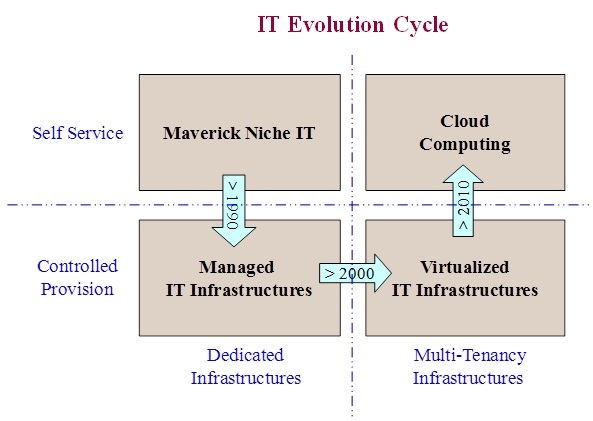
Referring to the other essential characteristics defined by NIST for Cloud Computing, for example, “pure” Virtualization” itself does not provide the customer a self-service layer and without that layer you cannot deliver Compute as a Service, i.e. a self-serving model however is not an essential component of virtualization, as it is in cloud computing. The next picture (quadrant) shows, on one hand, the evolution of IT technology in the last 3 decades (roughly) starting in the top-left corner (maverick niche IT) when any company department provisioned itself any IT infrastructure it wanted (according to its selves criteria), to when the provision was controlled and the management was unified but any department had its own machines (bottom-left corner or “managed IT infrastructures”), to last decade when the IT were provisioned and managed by IT department and shared by all or several departments (using virtualization), to the current times of Cloud Computing; and on the other hand, it also shows how self-service is one of the differentiation between Virtualization and Cloud computing (Note: I’ve used this quadrant other times since I saw in some publication, but I cannot remember where, so I apologize but I cannot refer it; besides I recreate it, so something could be changed).
 
IT Evolution Cycle
Break: In the above picture doesn’t appear the older times (lasting more than a decade) of mainframes, a realm where IBM was the king. In such environments the provision and management was controlled, and the infrastructures were shared, so it would be placed the same corner that virtualization, i.e. in the bottom right corner.  The transition from mainframes to the free-riders’ ”maverick niche IT” was due to several factors but, in my opinion, two were more significant: on one hand, the commercial labor of IBM competitors, as Digital, that offer to universities very low cost computers (as the VAX and PDP series of Digital) achieving that the computer sciences graduates wanted similar computers in his hew jobs, and on the other hand a disrupting technology as the emerging of PC (by IBM); both of them, among others fostered and fueled del “selfie” spirit (please, let me use this modern buzzword with a different meaning: the wish to be self-sufficient, as natural in human being) that boosts the gradual transition to the self-service dedicated infrastructures (i.e. from the bottom-right corner to the top-left one); and a last thought about this point: certainly Internet rising as well communications and other enterprise needs also contributed to this transition but, in my opinion, once the movement was already started.
 
Coming back to the self-service essential characteristic, some Virtualization Management Environments  include a self-serving component (but it’s not mandatory) as well as features to allow the customer to know how much usage it has made (metered services) and the resources are elastically provisioned and released (rapid elasticity). Once again, all this features are mandatory in the Cloud but they are optional in a “Virtualization Management Environments” since they are not intrinsic in the virtualization technology. In fact, a “Virtualization Management Environments” will become a Cloud Computing Environment if it meets all the 5 NIST essential characteristics, an evolution that, for example, VMware has been following these years … Given that in the enterprise market, VMware’s (ESX hypervisor and vSphere) virtualization management environment is king, let me analyze little deeper this last subject as an good example of this point:
  • Although I’m a supporter of Open Source and therefore of OpenStack when speaking about Cloud, it must be recognized that VMware has a powerful suite of virtualization and cloud products. Concerning to this point of discussion, right now two products must be discerned: “vCenter” and “vCloud Director”:
  • On one hand, vCenter is what manages your vSphere virtual infrastructure hosts, virtual machines, and virtual resources (CPU, memory, storage, and network), i.e. a pure virtualization management environment.
  • On the other hand, vCloud Director (vCD) is at a higher level in the cloud infrastructure. It´s a software solution providing the interface, automation, and management feature set to allow enterprise and service providers to supply vSphere resources as a Web-based service, i.e. it takes advantages of vCenter to orchestrate the provisioning of Cloud resources by enabling self-service access to compute infrastructure through the abstraction of virtualized resources. In other words, it abstracts the virtualized resources to enable users to gain self-service access to them through a services catalogue. i.e. it provides the self-service portal that accepts user requests and translates them into tasks in the vSphere environment via the vCenter.
  • In summary, vCenter is required to administer your virtual infrastructure but it doesn’t create a cloud. The first piece required to create your cloud is vCloud Director. vCloud Director will talk to your vCenter server/servers but certain tasks will have to be done first in vCenter, such as creating a HA/DRS cluster, configuring the distributed virtual switch, adding hosts, etc.
  • Note: By the way, now that VMware has announced that it splits vCloud Director into vCenter and vCloud Automation Center (a product that is derived from VMware’s DynamicOps acquisition) and it also seems that capabilities like multi-tenancy management and self-provisioning would be pushed into vCloud Automation Center (vCAC), while constructs like the Virtual Data Center would fall into vCenter, everyone that relly wants a Cloud environment with VMware it shall to buy (or migrate) vCAC, a heavyweight software, much like an IT service management product, requiring deep integration with IT business processes and an ERP-like implementation scenario, since pure vCenter will keep lacking the cloud-like self-service feature.
 
However, THERE ARE STILL MORE DIFFERENCES because according to NIST (and it’s intrinsic to the Cloud Definition) the “Resource pooling (multi-tenant)” property implies a sense of location independence in that the customer generally has no control or knowledge over the exact location of the provided resources but may be able to specify location at a higher level of abstraction (e.g., country, state, or datacenter)”. However, as you know, most of the “Virtualization Management Platform” let you choose in what physical machine your VM is going to run, o let you move your VM from a physical machine to another exact physical machine (chosen by the customer). In fact, some customers want (even need) such features, and that is one of the points that let know if the customer really wants or needs and Virtualization Environment or a real Cloud Computing Environment (for example, If you listen to your customer that he wants to move by himself its VM from one physical machine to another, he’s not specifying a Cloud environment, but a Virtualization Management Environment). This no location knowledge is also applied a other features as High Availability (HA), Fault Tolerance (FT) and so on: for example, in a Cloud Management Environment you can specify as much as a different “infrastructure area” (for example a different DataCentre, or something like) for locating the stand-by VM, however in a pure “Virtualization Management Environment” you’re able to choose the specific host (physical machine).
 
Moreover, and associated with the previous idea of no location knowledge, Cloud is intrinsically thought to massive scale out, i.e. without limit, and for physically (possibly in different places) distributed resources, but much of virtualization management environments are intended to manage a number reasonable (maybe big, but not enormous) of physical machines (hosts) and in most cases in the same emplacement.
 
Finally, as advanced at the beginning of this post, new customers needs are emerging to deploy applications on physical servers, instead of  virtual servers, but keeping all the cloud model advantages (and essential characteristics): that’s the case, for example, when your application requires physical servers, or your production environment is too performance sensitive to run in VMs. Actually you don’t need to have a virtualized environment to be considered a cloud environment: your “virtual” instance might be a “container” which is not virtualized but running on bare metal (just sharing it with other containers) or even running directly and using completely the bare metal: “containers”, as aforesaid, are considered by some authors as sort of virtualization, so let me expose an example of the second case: OpenStack is currently developing the new “Iron” module that it’ll provide “Baremetal as-a-Service”, so  it’ll be possible to use the same API and the same pipeline to build, test, and deploy applications on both virtual and physical machines. Therefore, cloud technology is starting to use other technologies away from pure paravirtualized environments.
 
So far, as consequence we’ve seen in the previous post and in the current one, we can conclude that:
  • Virtualization is an enabling technology for Cloud Computing, one of the building blocks used “generally” for building Cloud Computing solution (“generally” but not always, because nowadays Cloud is starting to use other technologies away from pure virtualized environments to offer  “Baremetal as a Services” …)
  • The services provided by “Cloud Computing Management Environment” and by a “Virtualization Management Environment” ARE QUITE DIFFERENT IN HOW THE SERVICES ARE PROVIDED:
    • the self service characteristic is mandatory in Cloud, and optional in a virtualization environment.
    • the location independence features (in the sense of no location knowledge) is intrinsically essential in Cloud, however most of virtualization environment lets know or operate with the location of VM.
    • massive scale out is also inherent to Cloud Environments, but much Virtualization Management Environment are only not prepared for manage “enormous” quantities of machines distributed in different emplacements.
 
Next post, I finalize this comparison focusing in a couple of technological differences:
  • The first one, “measured services”, in some way arise from the different business models that both, Virtualization and Cloud Computing, were INITIALLY intended for, and that will let me to compare those business models too.
  • For the second one, we will widen lightly the comparison scope to include (as usual) any computing related resources, (not only but also storage, and communications resources), and then we’ll analyze new differences: for example communications related Services (routing, firewalls, load balancing, etc.) are seldom (or never) offered as a Service in Virtualized Management Environments (in a self-service way and where you can self-define your internal communications layout and structure, and so on).
 
Note: Please, let me add that Tissat (the company I’m working for) is offering real IaaS Cloud Services as well more traditional DataCenter services (as housing, hosting, virtualized hosting, DRP, and so on) based on its Data Centers Federation (that includes Walhalla, a DC certified as Tier IV by The Uptime Institute) and using different product and solutions (currently VmWare, OpenStack, and so on) and most of ideas of this post series are extracted from that experience.

domingo, 12 de enero de 2014

Virtualization vs Cloud Computing (I): what are we going to compare?

In this post series (compound of two more posts) my final intention is to clarify the differences between a “Cloud Computing Management Environment” and a “Virtualization Management Environment”. To achieve it, first of all, I should clarify the differences between Cloud Computing and Virtualization, two technological concepts that are frequently confused or mixed, but there are significant differences between them. Finally, another goal is to differentiate between Cloud Computing as technological concept, from the Cloud Computing as a business model: some people thinks of Cloud Computing is only a Business concept (I hope to show they are wrong) and other confuse the initial business model Cloud Computing was intended for with the technological concept: currently (and Amazon it’s the best exponent of it) there are a lot of different or mixed business model to explode the Cloud Computing Services.
 
The first question is: Is it the comparison possible or are we going to compare apples with oranges?  I think the comparison is possible but in the appropriate and well defined scope.
 
So, first we need to spend some paragraphs clarifying both concepts, because both of them (by different reasons) use to be interpreted in different ways by different persons. First of all, let me say that I don’t want to state that my definition are the correct ones (besides they are not mines, I choose the at least, the most widely accepted currently), but the comparison will be based on these definitions, and no others, in order to be able to focus the points.
 
On one hand, “Virtualization” is an abstraction process that as an IT technology concept that arose in 60s, according to Wikipedia, as a method of logically dividing the mainframes resources for different applications. However, in my opinion, its diffusion and source of actual meaning is due to Andrew S. Tanenbaum author of, a free Unix-like operating system for teaching purposes, and also author the several very famous and well-known books as “Structured Computer Organization” (first edited in 1976), “Computer Networks” (first edited in 1981), “Operating Systems: Design and Implementation” (first edited in 1987) Distributed Operating Systems (first edited in 1995) and some of them, evolved and updated are still used in the Universities around the world for example, last edition of some of them have been in 2010. It also was a famous for its debate with Linus Torvalds regarding kernel design of Linux (and Torvarlds also recognized that “Operating Systems: Design and Implementation” book and MINIX O.S, were the inspiration for the Linux kernel; well, by the way , as you probably have notices, I’m biased in this subject because I like a lot of its book, and I used them  a lot when I was an University teacher). Coming back to the point, last edition of “Structured Computer Organization” in US was in 2006, but the first one was in 1976 where he already introduced the concept of Operating System Virtualization, a concept that he spread along all its books in different contexts treated.
 
Currently, in the IT area, “virtualization” refers to the act of creating a virtual (rather than actual) version of something, including but not limited to a virtual computer hardware platform, operating system (OS), storage device, or computer network resources. And between all of these concepts, in this post we are going to refer ONLY to the “Hardware virtualization”, i.e. the creation of a virtual machine (VM) that acts like a real computer with an operating system. Software executed on these virtual machines (VM) is separated from the underlying hardware resources. For example, a computer that is running Linux may host a virtual machine that looks like a computer with the Windows operating system; and then Windows-based software can be run on the virtual machine (excerpted from Wikipedia).
 
On the other hand, “Cloud Computing” is a concept that arise from several previous concepts Probably, I share the opinion of  more experienced people, is a mixture of two previous ideas; the “Utililty Computing” paradigm (a packaging of computing resources, such as computation, storage and services, as a metered service and provisioned on demand as the Utilities companies do) the “Grid Computing” (a collection of distributed computer resources collaborating to reach a common goal: a well-known example was the SETI program). Currently as everybody knows, Cloud it’s also a hyping concept that it’s misused for a lot companies that state to offer (fake) Cloud Services, but there are also plenty of real Cloud Services Providers. Besides I think Cloud Computing is an open concept that could be redefined in coming years in function of the way Customers (companies, organizations or persons) use its services and demands new ones, providers imagine and develops new services and, also, technical Advances enable new ideas or services. But, currently there’s a some good and clear definitions and, probably, the most used and accepted is the one of NIST that says: “Cloud computing is a model for enabling ubiquitous, convenient, on-demand network access to a shared pool of configurable computing resources (e.g., networks, servers, storage, applications, and services) that can be rapidly provisioned and released with minimal management effort or service provider interaction” and consequently,  disregarding the Service Model (IaaS, PaaS or Saas) and the Deployment Model (Private, Community, Public or Hybrid), states 5 Essential Characteristics for any CloudComputing service that I copy below (excerpted from NIST’s Cloud Definition) because it’s worth remembering them:
  • On-demand self-service. A consumer can unilaterally provision computing capabilities, such as server time and network storage, as needed automatically without requiring human interaction with each service provider.
  • Broad network access. Capabilities are available over the network and accessed through standard mechanisms that promote use by heterogeneous thin or thick client platforms (e.g., mobile phones, tablets, laptops, and workstations).
  • Resource pooling (multi-tenant). The provider’s computing resources are pooled to serve multiple consumers using a multi-tenant model, with different physical and virtual resources dynamically assigned and reassigned according to consumer demand. There is a sense of location independence in that the customer generally has no control or knowledge over the exact location of the provided resources but may be able to specify location at a higher level of abstraction (e.g., country, state, or datacenter). Examples of resources include storage, processing, memory, and network bandwidth.
  • Rapid elasticity. Capabilities can be elastically provisioned and released, in some cases automatically, to scale rapidly outward and inward commensurate with demand. To the consumer, the capabilities available for provisioning often appear to be unlimited and can be appropriated in any quantity at any time.
  • Measured service. Cloud systems automatically control and optimize resource use by leveraging a metering capability at some level of abstraction appropriate to the type of service (e.g., storage, processing, bandwidth, and active user accounts). Resource usage can be monitored, controlled, and reported, providing transparency for both the provider and consumer of the utilized service.
 
Besides, to make the comparison possible we must focus ONLY in the Infrastructure as a Service (IaaS), that is defined by the NIST as The capability provided to the consumer is to provision processing, storage, networks, and other fundamental computing resources where the consumer is able to deploy and run arbitrary software, which can include operating systems and applications. The consumer does not manage or control the underlying cloud infrastructure but has control over operating systems, storage, and deployed applications; and possibly limited control of select networking components (e.g., host firewalls)” and in this discussion we forget other service models as PaaS and SaaS. Besides, as in the virtualization concept case, to easy the comparison we ONLY speak about the “compute resource” inside the IaaS Cloud Computing concept.

Inside this scope and context, virtualization is one of the technologies used to make a Cloud, mainly to supply (implement) the “resource pooling (multitenant)” characteristic (following the NIST definition). Besides, currently it is most important technology enabling such goal, but not the only one since other could be used, for example containers (although some people consider containers as sort of virtualization), or grid technologies (as the SETI program). Besides, other developments or software are needed to provide the remaining features required to be a real Cloud (NIST definition). Some authors consider “Orchestration” as what allows computing to be consumed as a utility and what separates cloud computing from virtualization. Orchestration is the combination of tools, processes and architecture that enable virtualization to be delivered as a service (quoted from this link). This architecture allows end-users to self-provision their own servers, applications and other resources. Virtualization itself allows companies to fully maximize the computing resources at its disposal but it still requires a system administrator to provision the virtual machine (VM) for the end-user. In other words, Virtualization is an enabling technology for Cloud, one of the building blocks used for Cloud Computing.
 
However, in the next 2 posts of this series we’ll review this last point  because of both the recently arisen new needs of customers and the innovations and technological advances; i.e. the previous paragraph will be revisited, since cloud technology is currently starting to use other technologies away from pure virtualized environments (as containers or “baremetal as a Service”).
 
Besides, and what it’s more important, we also see that the differences between Cloud and Virtualization go beyond of the well-known and aforesaid “Virtualization is an enabling technology for Cloud, one of the building blocks used for Cloud Computing”. We will analyze more differences: self service feature, location independence (in the sense of no location knowledge), massive scale out, even metered service in some cases, and so on, and we will conclude that  BOTH ARE QUITE DIFFERENT IN HOW THE SERVICE IS PROVIDED (to be shown next week).
 
And let me advance that we’ll also differentiate between the two pure business models they were “initially” intended for: hosting virtual (a fixed monthly rate, but lower that physical hosting rate) and pay-per-use (that some person call the Cloud Computing business model, even the confuse the Cloud technology with the Cloud business model): some people confuse the technologic concepts with the business models;  besides it should be taken into account that at the present there are a lot of mixed or hybrid business models disregarding the underlying technology, what increases the confusion too.
 
Moreover, coming back to the technological arena, when we will widen lightly the comparison scope to include (as usual) any computing related resources, (not only but also storage, and communications resources), then new differences will arise as we’ll analyze in the third (last) post of this series: for example communications related Services (routing, firewalls, load balancing, etc.) are seldom (or never) offered as a Service in Virtualized Management Environments (in a self-service way and where you can self-define your internal communications layout and structure, and so on).

domingo, 15 de diciembre de 2013

OpenStack keeps gaining momentum in Cloud market, as evidenced by Oracle support, in spite of Gartner opinion

A few weeks ago, Gartner analyst Allessandro Perilli recently says the project has a long way to go before it’s truly an enterprise-grade platform. In fact, in a blog post he says that “despite marketing efforts by vendors and favorable press, enterprise adoption remains in the very earliest stages” … The main reasons for that, in its opinion, are:
  • Lack of clarity about what OpenStack does.
  • Lack of transparency about the business model.
  • Lack of differentiation.
  • Lack of pragmatism.

OpenStack backers rebuffed such claims, and I must recognize that I’m biased because I work in a European company (Tissat, based in Spain, and with several DataCentres and one of them -Walhalla- certified as Tier IV by the Uptime Institute) that offer IaaS Services using OpenStack. But I also have to recognize that OpenStack is a solution that is continuously evolving and growing, and therefore I agree with some of the statement of Mr.  Perilli, but I disagree with its main conclusion:

Maybe he’s right and the fact that big companies are contributing to its code as well as they also are supporting and using it to deliver services it’s unusual, but let me mention some of them that are supporting and using it: RackSpace and Nasa (maybe they aren’t the biggest, but they were the first ones), IBM (IBM’s open cloud architecture), HP (HP Cloud Services), Cisco (WebEx Service), they don’t seem small player, do they?  (I beg your pardon for the irony). Besides, relatively smaller companies are contributing to, supporting and selling services on OpenStack as the traditional Linux Distro Providers: RedHat, Novell (Suse), Canonical (Ubuntu). Finally other big player that are using OpenSack are PayPal-eBay, Yahoo, CERN (the European Organization for Nuclear Research), ComCast, MercadoLibre, Inc. (e-commerce services), San Diego Supercomputer Center, and so on., that aren’t small player either …

Could you think in player in the IT providers market as big as the firsts mentioned? Sure, Microsoft, Google, Oracle, … Well, surprise, last week Oracle announced that they embrace OpenSatck. Yes, although Oracle acquired Nimbula on March (and maybe the Nimbula shift from its own proprietary private cloud approach to become an OpenStack-compatible software supplier was the first sign of the change), they are going to integrates OpenStack cloud with its technologies: “Oracle Sponsors OpenStack Foundation; Offers Customers Ability To Use OpenStack To Manage Oracle Cloud Products and Services”. Oracle’s announcement said that:
  • Oracle Linux will include integrated OpenStack deployment capabilities.
  • Solaris too will get OpenStack deployment integrations
  • Oracle Compute Cloud and Oracle Storage Cloud services will be integrated with OpenStack
  • Likewise, Oracle ZS3 Series network attached storage, Axoim Storage Systems, and StorageTek Tape Systems will all get integrated.
  • Oracle Exalogic Elastic Cloud hardware for running applications will get its own OpenStack integration as well.
  • And so on.
i.e. Oracle speaks about a significant new support for OpenStack in an extremely ambitious manner, pretty much saying that it would support OpenStack as a management framework across an expansive list of Oracle products. Evidently, Oracle movement is a great support for OpenStacck (and for my thesis, too, and probably another point against Mr. Pirelli’s opinion) …

However, to be honest,  let me doubt (at the moment) about the ultimate motivations and objectives of Oracle: I’ve got the impression that Oracle is simply ceding to the pressing of the market, adjusting to the sign of the times, but it’s not committed to what makes OpenStack means: a collaborative and inclusive community: On one hand,  as I stated that in my  “Cloud Movements (2nd part): Oracle’s fight against itself (and the OpenStack role)”  post that Oracle is fighting against itself due to its traditional and profitable business model is challenged by the Cloud model, and it has been delaying its adoption as much as possible (as IBM did when its mainframes ran mission-critical applications on legacy databases, and a new -by then- generation of infrastructure vendors -DEC, HP, Sun, Microsoft and Oracle- challenged it and disrupted the old IBM model): it was conflicted about selling the lower-priced, lower-margin servers needed to run them (even Oracle CEO Larry Ellison used to disdain Cloud Computing, e.g. he called cloud computing “nonsense” in 2009). On the other hand, the recent Oracle announce doesn’t necessarily imply a change in this matter.

Besides the Oracle movement raise suspicions, even disbelief, not only in me but in other people. Let me quote some paragraphs of Randy Bias’ (co-founder and CEO of cloud software supplier CloudScalin post titled “Oracle Supports OpenStack: Lip Service Or Real Commitment?”. Randy’s position could be summarized in its words Oracle is the epitome of a traditional enterprise vendor and to have it announce this level of support for OpenStack is astonishing”. Randy also wonders “Can Oracle engage positively with the open-source meritocracy that OpenStack represents? Admittedly, at first blush it’s hard to be positive, given Oracle’s walled-garden culture.” And to back its answer, Randy review some Oracle facts:
  • Oracle essentially ended OpenSolaris as an open-source project, leaving third-party derivatives of OpenSolaris (such as those promulgated by Joyent and Nexenta) out in the cold, having to fork OpenSolaris to Illumos.
  • Similarly, the open-source community’s lack of trust can be seen ultimately in the forking of MySQL into MariaDB over concerns about Oracle’s support and direction of the MySQL project. Google moved to MariaDB, and all of the major Linux distributions are switching to it as well”.


However, finally Randy concludes: It’s hard not to have a certain amount of pessimism about Oracle’s announcement. However, I’m hopeful that this signals an understanding of the market realities and that its intentions are in the right place. We will know fairly soon how serious it is based on code contributions to OpenStack, which can be tracked at Stackalytics. (So far, there are zero commits from Oracle and only two from Nimbula, Oracle’s recent cloud software acquisition.). Personally, I’m happy to see Oracle join the party. It further validates the level of interest in OpenStack from the enterprise and reinforces that we’re all building a platform for the future”.

And the last words of Randy gets me back to my initial point: I really think OpenStack is already a mature enough platform to make business (in all the ways other IT products or solutions) as the giants and other big companies of IT area are showing (IBM, HP, Cisco, Oracle, RackSpace, Yahoo, PayPal, ComCast, RedHat, Novell, Canonical, etc.).

Finally, let me end this post with some partial pictures extracted from an Infographic elaborated by OpenStack (you can get the whole infographic here):

The current OpenStack deployment comprises 56 countries:
Current OpenStack Deployments

Covering any-size organizations and a wide range of industry sectors:
Current OpenSatck Organizations Size        Current OpenStack Industry Sectors

Besides, any type of deployments is currently made:
Current OpenStack Type of Deployments
And currently the 10 types of applications most deployed on OpenStack are:
Current OpenStack Type of Workloads

miércoles, 18 de septiembre de 2013

Tissat resulta adjudicataria del Acuerdo Marco 27/2012 para la contratación de Servicios de Alojamiento de Sistemas de Información

Tissat ha sido homologada por la Dirección General de Patrimonio para actuar como proveedor de servicios en contratos con la administración pública en base al actual catálogo de servicios 27/2012. Esta nueva adjudicación le permite trabajar con la administración pública como proveedor de servicios relacionados con el Alojamiento de Sistemas de Información (housing, hosting dedicado, hosting virtual, Cloud…).
 
Este éxito se fundamenta en que Tissat gestiona y opera en estos momentos 5 DataCenter:
  1. “Walhalla”, sito en Castellón, certificado como Tier IV por The Uptime Institute.
  2. “Parc Tecnologic”, sito en Paterna (Valencia), Tier III.
  3. “Brasil”, sito en Madrid.
  4. 112-RM, sito en Murcia.
  5. 112-CV, sito en L’Eliana (Valencia).
De ellos los 3 primeros son de su propiedad, y los 3 han sido homologados dentro del Acuerdo Marco 27 de Catálogo de Patrimonio (“Servicios de Alojamiento de Sistemas de Información”) que se acaba de adjudicar hace unos días, obteniendo además el primer puesto en la evaluación, y que contempla principalmente los siguientes servicios:
  • Servicios de alojamiento de sistemas de información (housing, hosting dedicado, hosting virtual, cloud hosting, etc.).
  • Servicio de puesta en marcha asociado a los servicios de alojamiento.
  • Servicio de respaldo y recuperación asociado a los servicios de alojamiento.
  • Servicio de comunicaciones asociado a los servicios de alojamiento.
  • Servicio de monitorización asociado a los servicios de alojamiento.
  • Servicio de explotación asociado a los servicios de alojamiento.
  • Servicio de seguridad asociado a los servicios de alojamiento.
  • Servicio de estadísticas e informes.
 
Por otra parte, el diseño de estos 5 centros DataCenter ha sido realizado también por Tissat. De la calidad de los diseños de Tissat da fe los premios que ha obtenido, así por ejemplo la revolución que supone Walhalla queda avalada por la obtención en Diciembre del 2010 en Londres del prestigioso premio “Innovation in the medium Date Centre” en los Data Centre Leaders Awards, gala en la que se encuentran cada año los proyectos más innovadores y las apuestas más rompedoras del marco europeo de los Centros de Procesos de Datos. Además, Tissat no sólo obtuvo un galardón, sino que también quedó finalista en la categoría de “The Green Data Centre”, hecho que demuestra el enorme compromiso de Tissat con el Medioambiente y su apuesta por el ahorro energético, como lo demuestra el PUE de 1,15 con el que opera Walhalla.
 
Además Tissat ha certificado la gestión y las operaciones de todos sus DataCenter de acuerdo a las siguientes normas:
  • ISO 20.000
  • ISO 27.001
  • ISO 50.001
  • ISO 14.001
  • ISO 9001
  • EU Code of Conduct for DataCentres.
  • Y la reciente (publicada a primeros de año) AENOR EA 0044:2013, que certifica la sostenibilidad energética de un CPD, y que hemos sido los primeros en obtener.
 
En palabras de la Directora de Tissat Madrid, Carmen García, “con esta adjudicación Tissat se sitúa a la vanguardia de las mejores compañías TIC a nivel nacional y demuestra una vez más su capacidad y solvencia financiera, tecnológica y profesional pues la evaluación de nuestros DataCenters y servicios ha superado todos los criterios de evaluación con Matrícula de Honor”. 

jueves, 12 de septiembre de 2013

Third-Party DataCentres are becoming increasingly attractive rather than Enterprise DataCentres, according to a recent Uptime Institute’s Survey

The Uptime Institute, a division of The 451 Group, recently has published the results of its third annual “Data Center Industry Survey” (2013). The survey was developed to collect data on an annual basis around Digital Infrastructure deployment trends, procurement plans, operations and management practices, and other topics that impact the mission-critical data center industry.
Note: You can get a free copy of 2013 report at http://uptimeinstitute.com/2013-survey-results and the 2012 one at http://uptimeinstitute.com/2012-survey-results.
 
This year, the survey  gathers responses  (during spring 2013) from 1,000 data center facilities operators, IT managers and senior executives from around the world (mainly from North America but with a growing number from Europe, Asia and Latin America) and most of them have responsibilities for more than one site. The survey covers different areas as DC budgets, Cloud Computing, Energy Efficiency and Green certifications, DCIM adoption, and so on.
 
It shows consolidation in tendency in most areas but also some surprising trends changes:
  • The global average of the PUE numbers the respondents were seeing was reported to be at 1,65, a great reduction from the 1,98 reported in 2012 survey, or the one of 2.5 reported in 2011.
  • The percentage of companies pursuing green data center certifications like US Green Building Council’s LEED program or Energy Star grew from 48% in 2012 to 58% in 2013.
  • Furthermore, the survey found that Enterprise public cloud adoption rose from 10% in 2012 to 17% in 2013, however private cloud adoption decrease slightly: only 44 per cent deploying private clouds this year, compared with 49 per cent in 2012. According to survey “This seems to suggest that the companies who could make use of a private cloud platform have made the investment, and companies on the fence are either going to public cloud or walking away from the hype cycle” . It also said that large enterprises are almost twice as likely to implement public clouds than smaller enterprises.
  • Prefab modular DC designs are on the slide: 53% of respondents said no interest from the last year 42%; and adoption is still around 8% as in the 2012 survey (however 2012 doubled 2011).
  • Reported DCIM software adoption is high, a 38% among respondents, with the major driver being capacity planning. (Note: however in 2012, in spite of  enormous interest in and that a fair percentage were already using tools that could be described as DCIM,  there was no single concerted focus on what DCIM needed to be deployed).


However, probably, the new and most significant result found is that are the most significant DataCenter budget grow is occurring in the “third party” companies (77% of third-party data centre providers said they had received large, 10% or more, year-over-year budget increases this year, compared with just 47% of enterprise data centres), reflecting a shift in spending away from enterprise-owned data centres and toward outsourced options. According to Matt Stansberry, Uptime Institute director of content and publications, “This isn’t the end of the enterprise-owned data centre, but it should serve as a wakeup call. Going forward, enterprise data centre managers will need to be able to collect cost and performance data, and articulate their value to the business in order to compete with third-party offerings”.
 
Note: The Uptime Institute defines “third party” in this surveys as “companies that provide computing capacity as service in any form” (SaaS or other cloud computing services, multi-tenant collocation, or wholesale DC providers).

jueves, 11 de julio de 2013

TISSAT y GFI suman sus tecnologías para dar soluciones de virtualización en la nube

Tissat, empresa española especializada en el outsourcing de servicios de misión crítica y proveedora de servicios Cloud Computing, ha firmado un acuerdo con la empresa GFI Informática, empresa de Consultoría y Servicios informáticos con presencia internacional, para ofrecer una solución completa a sus clientes.
 
En virtud de este acuerdo, Tissat aportará sus soluciones Cloud en la nube, su infraestructura de referencia, Walhalla, el primer centro de datos español comercialmente disponible con certificación Tier IV y capacidad para ofrecer alojamiento a nivel internacional y su plataforma para dar soluciones cloud.
 
Por su parte, GFI Informática contribuye con su experiencia en desarrollo de software a medida para dotar a esta solución de la integración y mantenimiento requeridos para dar una solución personalizada a cada cliente.
 
En palabras de Carmen García, Directora de Tissat Madrid, “es momento de sumar para poder ofrecer a los clientes la mejor solución y servicio en un sector en el que existe una amplia oferta de tecnologías, muchas veces desconocidas por las empresas para optimizar su gestión y garantizar la máxima seguridad posible”.
 
“El acuerdo que hemos suscrito con Tissat  permitirá a  GFI proporcionar soluciones de Cloud Computing a nuestros clientes, principalmente en entornos que requieren de una certificación especial, en unas condiciones muy ventajosas y competitivas”, ha comentado Javier Uriarte, Director  de Desarrollo de Negocio de GFI.
 
A cerca de GFI Internacional
GFI Internacional es una empresa de Consultoría y Servicios Informáticos con presencia internacional en más de siete países y una fuerte implantación en Francia, donde se ha convertido en una de las marcas más conocidas en el sector de los servicios informáticos. Proporciona soluciones globales y un amplio abanico de servicios avalados por la certificación ISO 9001. www.gfi.es

miércoles, 3 de julio de 2013

Tissat Recertifies its Energy Efficiency and Design in its Data Centers and Reobtains the ISO 50001 Standard

Tissat, leader in the field of Data Centers and owner of Walhalla, the first Tier IV Data Center offering these services in Spain, becomes one of the only two companies in Spain that have obtained this quality certification and energy efficiency for its Data Centers.
 
This standard specifies requirements for establishing, implementing, maintaining and improving an energy management system, allowing Tissat to have a systematic approach and thus achieve continuous improvement in energy performance, including energy efficiency, energy security, energy use and consumption. This certificate helps Tissat continually reduce its use and its costs of energy and the emission of greenhouse gases.
 
The application of this standard for about two years as well as the monitoring of the best practices established by the “European Code of Conduct for Data Centers”, along with other measures that accompany and support this standard (ex. DCIM system) have allowed to the Tissat’s Data Center Walhalla reaching a PUE of 1.15, measured according to the strict and continuous level measurement of type 3 defined by ASHRAE, the Green Grid, the Uptime Institute and so on.
 
Note: This TISSAT certification have been recently improved by the AENOR’s EA0044:2013 Data Centres Energetic Sustainability Certification,  that  accredits that a Data Centre accomplishes with the established energy audits, as well as energy and carbon footprint management systems, contributing to mitigate climate change.
 
 
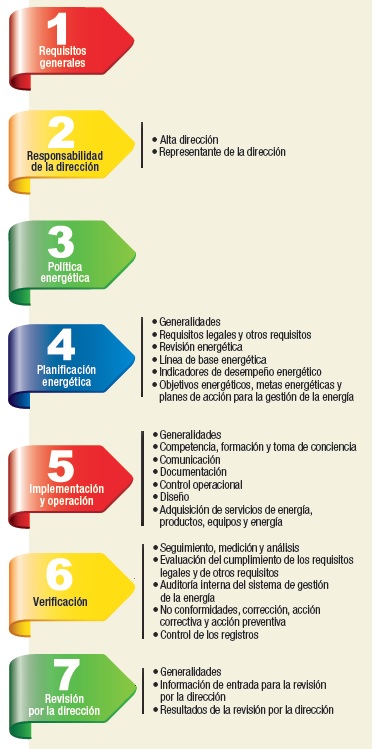
Requisitos establecidos y compromisos adquiridos ISO 50001

jueves, 13 de junio de 2013

Reasons for Data Centres Energetic Sustainability Certification

As announced in my last post  today I resume the subject of Data Centres Energetic Sustainability Certification and the AENOR EA 0044.2013 Technical Specification, publishing an interview made to my coworker Nuria Lago, who lead our certification process, about the TISSAT’s reasons for and the results of this certification.
 
Note: once again I apologize for not translating this interview, but for people that don’t understand Spanish, on-line translators will do better than me.
 
 
¿Qué fue lo que motivó a Tissat a adoptar esta especificación técnica de sostenibilidad en los centros de datos?
En primer lugar, la diferenciación frente a otros posibles actores del sector. De esta manera, TISSAT ofrece a sus clientes mejores garantías y responde a los más altos niveles de exigencia en aspectos de valor para los mismos, en particular en el ámbito de la sostenibilidad. Y, en segundo lugar, afianzar la reputación e imagen de la compañía, asociando nuestra marca a los últimos y más exigentes estándares, en este caso de eficiencia y sostenibilidad.
 
 
¿Cómo fue el proceso de implantación? ¿Qué retos y fortalezas encontraron?
Para una empresa de Tecnologías de la Información, suponía un gran reto orientarse hacia la industrialización de procesos, pues no es nuestro core de base de negocio. Así, esta certificación constituye una gran oportunidad para ampliar la perspectiva de negocio y reenfocar la explotación de los servicios a través de la eficiencia de energía, y por ende, la reducción de costes. También nos ha permitido tener una percepción mejorada sobre la prestación de los servicios de extremo a extremo, ampliando la visión hacia la parte de energía.
 
 
¿Qué reducciones de consumos energéticos han registrado?
Estamos muy enfocados al retorno de la inversión, puesto que la sostenibilidad y eficiencia contribuyen a optimizar los costes energéticos de los Centros de Procesos de Datos, maximizando así el beneficio obtenido en la operación de los mismos. Se trata de una pieza clave, ya que nuestro consumo energético es extremadamente elevado debido a la infraestructura tan compleja con la que se opera (Sistema de Alimentación Ininterrumpida, iluminación, climatización, equipamiento TI, motores, etc.) por lo que cualquier ajuste, por pequeño que parezca, supone un gran ahorro a largo plazo. El sistema de Gestión de Energía y la Huella de Carbono permiten tener una visión clara sobre qué medimos, dónde estamos, pero sobre todo a dónde queremos llegar. Supone incorporar un sistema que te permite aprender, mejorar cada día, y optimizar consumos prácticamente mes a mes, sabiendo además que estás contribuyendo a reducir las emisiones de CO2.
 
 
¿Cuáles son a su juicio las ventajas más destacadas de esta certificación?
Tissat es una empresa de misión crítica con un gran volumen de servicios que se prestan a través de sus Centros de Procesos de Datos, por lo que es muy importante poder demostrar la excelencia de su operación. Además, Walhalla es un Datacenter de última generación, que representa un modelo de industrialización de CPD con diseño y desarrollo propio, preparados para albergar servicios de cloud computing y con capacidad para ofrecer alojamiento en el ámbito internacional.

jueves, 6 de junio de 2013

Data Centres Energetic Sustainability Certification

In my post of 06-feb-2013 I announced that TISSAT’s Walhalla was the first Data Center awarded with the AENOR’s Data Centres Energetic Sustainability Certification. Note: Walhalla is also Tier IV certified by The Uptime Institute.
 
As explained in that post, AENOR’s “EA0044:2013” certification accredits that Data Centres accomplishes with the established energy audits, as well as energy and carbon footprint management systems, contributing to mitigate climate change. The result of all this certifies the Energetic Sustainability of TISSAT’s Data Centers, placed in Castellon and Valencia, a logical corollary of our continuous R&D and innovation processes in the Green Data Center área.
 
In short, EA0044:2013 Technical Specification, AENOR certifies that:
  • TISSAT has realized an energy audit of Walhalla according to UNE 216501,
  • the results and improvement proposals resulting from that audit have been included in the Tissat’s ISO-50001:2011 certified EMS (Energy Management System),
  • and that carbon footprint has been calculated accomplishing the ISO 14064-1.
 
Please let me speak something more about what is that certification and how it can be achieved. However I‘m going to do in Spanish, since I’m going to copy some paragraphs from an AENOR’s paper just published in website (http://www.aenornet.es/revistaune/pdf/mayo13/28mayo13.pdf):
 
La Unión Europea ha aprobado algunas disposiciones regulatorias en materia de residuos, sustancias peligrosas y consumo de energía de aparatos eléctricos y electrónicos comúnmente utilizados en CPD. También ha publicado un código de buenas prácticas para este tipo de servicios, cuyos requisitos, específicos para el sector de las TIC se han adoptado en la especificación AENOR EA 0044:2013, de sos­tenibilidad energética en CPD.
 
La auditoría energética aporta información acerca del estado y comportamiento energético de la instalación en un momento dado: sus posibilidades de mejora, potencial de ahorro energético y económico, repercusiones de  las mejoras en el mantenimiento así como las inversiones asociadas. Es imprescindible para una correcta realización de la auditoría energética definir tanto su ámbito físico, como el alcance técnico de la auditoría. En el siguiente cuadro se muestran las fases de una auditoría energética:
 
Etapas de Auditoría Energética-AENOR
 
 
Para asegurar la validez de los datos aportados por la auditoría energética, se debe verificar que ha sido realizada y documentada por personal competente, de acuerdo con lo establecido en la Norma UNE 216501 sobre auditoría energética o en futuras normas internacionales reconocidas por las partes interesadas implicadas.
 
Por su parte, el Sistema de Gestión de la Energía aporta información acerca del uso y consumo de la energía, las variables que afectan al desempeño energético del CPD, el propio desempeño energético y su evolución mejorada frente a una o varias líneas base de referencia establecidas, así como las prácticas para el diseño, adquisición de datos, medición, documentación e información sobre la energía. El servicio de CPD debe asegurar que  cumple los requisitos establecidos y los compromisos adquiridos en su política energética declarada de acuerdo con la Norma UNE-EN-ISO 50001:2011. Asimismo, la implantación y mantenimiento del Sistema de Gestión de la Energía también debe realizarse y documentarse de acuerdo con lo establecido en la mencionada norma y realizarse por personal competente.
 
Por otra parte, el cálculo de los Gases de Efecto Invernadero (GEI) aporta infor­mación acerca del desarrollo e imple­mentación de estrategias y planes de reducción de estos gases en el servicio de los CPD, facilitando su seguimien­to anual y el progreso en la reducción.
 
Resulta ineludible determinar los límites objeto del cálculo de las emisiones y remociones (en su caso) de estos gases, con el fin de disponer de una misma base comparativa e identificar actividades y acciones destina­das a la mejora de la gestión de los mismos. Para ello, la Huella de Carbono de la prestación del servicio de los CPD deberá asegurar lo establecido en la Norma UNE-EN-ISO 14064-1 y en el GHG Protocol, como se esquematiza en el siguiente cuadro:
 
Fases del Cálculo de Emisiones GEI-AENOR


Probably next post I resume this subject, publishing an interview made to my coworker Nuria Lago, who lead our certification process, about the TISSAT’s reasons for and the results of this certification.
 
 
Note. AENOR is the Spanish Association for Standardization and Certification, that was founded in 1986, and is working in more than 60 countries, been among the 10 most important certification organizations in the world, and contributing to improving the quality and competitiveness of companies, their products and services.

viernes, 31 de mayo de 2013

Tissat con su DataCenter Walhalla ha ganado el premio “ONDA CERO CASTELLÓN” en la categoría de EMPRESA


Si el año pasado fue la Cadena SER quien otorgó un premio al Data Center Walhalla (tras haber recibido el DataCenterLeaders Award en el 2010 reconociendo la excelencia en su diseño), este año ha sido la Cadena “Onda Cero” quien ha premiado a Tissat por su DataCenter Walhalla.

El mundo de la cultura, el deporte, la educación y las tradiciones se dió cita anoche, 30 de mayo, en el Teatro Principal de Castellón, en el acto de entrega de los XII Premios “Onda Cero Castellón”, con los que la emisora ofreció una fotografía fija de la sociedad castellonense, su tejido empresarial y su compromiso social y su emprendedurismo.

Con estos premios, Onda Cero Castellón, reconoce anualmente a personas, colectivos y entidades cuyo trabajo ha tenido una repercusión importante en el progreso, el desarrollo y la calidad de vida de la sociedad de la provincia de Castellón. El objetivo de estos premios es reconocer acciones que a veces, pasan desapercibidas para los medios de comunicación y, sin embargo, son parte de su historia y su progreso.

En la presente edición el jurado ha reconocido la labor de:

  • la Asociación Cultural Nueva Jerusalem (Premio a la Iniciativa Vecinal),
  • el ayuntamiento de Onda por su iniciativa de asumir los alquileres para desahuciados (Premio de la Integración Social),
  • la website “Las Villas” (Premio de la Comunicación),
  • el conde de Cirat por la donación de su legado a la provincia (Premio de la Cultura),
  • el pintor César Díaz Naya (Premio de las Artes Plásticas),
  • Juanjo Carratalá (Premio de la Música),
  • el club Big Twin (Premio del Turismo),
  • el Proyecto Campeones (Premio de la Solidaridad),
  • Walhalla de Tissat (Premio de la Empresa),
  • el congreso Enrédate (Premio de la Economía),
  • el Centro de Tecnificación Deportiva de Penyeta Roja (Premio de la Educación),
  • el club Marató i Mitja (Premio de los Deportes),
  • la rogativa Catí-Castellfort (Premio de las Fiestas),
  • la doctora Isabel Tena (Premio de la Salud)
  • la Asociació Juvenil Enredadera Jove de la UJI (Premio del Medioambiente).

El codirector de Radioestadio y colaborador de La Brújula de Onda Cero, Javier Ruíz Taboada, fue el encargado, junto con la periodista de Onda Cero Castellón, Lorena Pardo, de presentar la ceremonia de entrega de estas distinciones, un acto público que la emisora organizó con el objetivo de que los premiados reciban el homenaje de la sociedad castellonense.

Los XII Premios “Onda Cero Castellón” cuentan con el patrocinio institucional del Ayuntamiento de Castellón y la Diputación Provincial de Castellón.

Se incluye el podcast de la entrevista realizada a nuestro Director General (Manuel Escuín) por Onda Cero en relación a este premio: pinchar aquí

martes, 28 de mayo de 2013

Tissat and Open Up joint for offering Cloud Services

Tissat y Open Up se han unido para ir juntos al mercado de servicios cloud. Tissat apotará su oferta de infraestructura y servicios cloud, y Open Up sus servicios integrales para DataCenters.
 
Más en concreto, Tissat aporta a la alianza sus servicios cloud y de consultoría y su centro de datos Walhalla, el primero de nuestro país comercialmente disponible con certificación Tier IV.
 
Por su parte, Open Up contribuye con su conocimiento en la instalación y mantenimiento de este tipo de infraestructuras críticas, ofreciendo servicios de instalaciones eléctricas, cableado, logística, suministro y mantenimiento de centros de datos.
 
En palabras de Carmen García, directora de Tissat Madrid, “en un momento como el actual la expansión empresarial pasa por sumar esfuerzos y complementar nuestra oferta para poder ofrecer un servicio integral a nuestros clientes y ampliar el marco de actuación, no sólo a nivel geográfico, sino en lo que a oferta de servicios se refiere”.
 
Según Carmen Heredero, directora de Open Up, “la colaboración y suma de esfuerzos es una ventaja competitiva en el mercado actual, ya que se potencian las cualidades de ambas organizaciones. Este proyecto de colaboración nos permite ofrecer un servicio final en los Data Centers de calidad y alto valor añadido”.

martes, 19 de marzo de 2013

Interoute y Tissat refuerzan su acuerdo de colaboración para ofrecer servicios de Consultoría TIC

Interoute colabora con su amplia oferta de infraestructura de comunicaciones y sus Centros de Datos Europeos y Tissat aportará su experiencia en soluciones en DRP (Recuperación de Desastres) y continuidad de negocio, Cloud, Backup y Escritorio Virtual as a Service, entre otros servicios

 
Interoute, el operador con la mayor plataforma de servicios cloud de Europa, ha firmado un acuerdo de colaboración y apoyo mutuo con Tissat, propietaria del centro de datos más avanzado de Europa denominado Walhalla, para impulsar los servicios de Consultoría TIC a nivel internacional.
 
En virtud de este acuerdo, Tissat aportará su experiencia en proyectos de consultoría TIC especialmente en soluciones de Recuperación de la información ante Desastres y Continuidad de Negocio, además de sus soluciones cloud IaaS Storage as a Service, Backup as a Service y Escritorio Virtual as a Service, que completan la oferta de IaaS de Interoute con su servicio en sus Centro de Datos distribuidos por Europa. Además, Tissat aporta sus soluciones verticales de Estrategia Social Media, Social CRM, Social Buzz Monitoring, Social E-Commerce, Colaborative – Crowd-Computing, Gestión de Flotas, Cuadro de Mandos, Movilidad Urbana y Administración Electrónica.
 
Por su parte, Interoute colabora con su amplia oferta de infraestructura de comunicaciones y sus diferentes Centros de Datos Europeos, entre los que figuran los propios de Tissat, ya que ambas empresas mantienen un acuerdo de colaboración desde enero de 2012, por el que Tissat se integra en la red paneuropea del operador, permitiendo a ambas empresas ofrecer servicios de manera conjunta en esta red de Centros de Datos.
 
Walhalla es el único centro de datos español y uno de los principales europeos que puede ofrecer servicios de alojamiento de datos y aplicaciones a las empresas con las máximas garantías de seguridad y confidencialidad de los datos allí alojados, así como disponibilidad y continuidad del servicio. Dispone de capacidad para guardar todos los datos de empresas e instituciones con un volumen de información importante, desde administraciones públicas a grandes multinacionales.
 
En palabras de Carmen García, Directora de Tissat Madrid, “es un placer para nosotros ampliar el objeto de colaboración del acuerdo que ya manteníamos con una empresa del prestigio de Interoute, aportando nuevas soluciones y servicios, ya que ambas empresas podemos, desde la colaboración, revalorizar y diversificar nuestra oferta y ampliar el ámbito de nuestras colaboraciones”.
 
Diego Matas, director general de Interoute Iberia, ha comentado: “Tissat aporta un valor añadido a nuestra oferta de soluciones y estamos satisfechos de reforzar nuestro acuerdo y seguir colaborando juntos para satisfacer la demanda de nuestros clientes”.
 
 
Nota:
Interoute es la compañía propietaria y operadora de la red privada de voz y datos más avanzada y mejor conectada de Europa, con más de 60.000 Km. de fibra iluminada, 9 centros de datos integrados en su infraestructura, 32 centros especializados de alojamiento compartido de equipos (co-location) integrados en la red y conexiones con 140 centros de datos gestionados por terceros en toda Europa. Su plataforma Unified ICT da servicio a compañías internacionales de diversos sectores, desde los antiguos monopolios de telecomunicaciones de Europa y los principales operadores de América del Norte, Este y Sur de Asia a gobiernos y universidades. Estas organizaciones encuentran en Interoute al socio idóneo para gestionar sus soluciones de telecomunicaciones y el desarrollo de servicios de Valor Añadido.
Su estrategia Unified ICT ha demostrado ser muy atractiva para organizaciones que buscan una plataforma escalable, segura y sin restricciones para alojar sus aplicaciones de voz, vídeo, informática y datos, así como para los proveedores de servicios que necesitan alta capacidad internacional para tránsito de datos e infraestructura. Con operaciones en los principales países europeos, Norteamérica y Dubái, Interoute también posee y opera redes metropolitanas en los principales centros de negocios de Europa.

miércoles, 6 de febrero de 2013

TISSAT’s Walhalla is the first Data Center awarded with the AENOR’s Data Centres Energetic Sustainability Certification


TISSAT is proud to announce that Walhalla, its Data Center located in Castellón (Spain) and Tier IV certified by The Uptime Institute, just obtained the Energy Sustainability Certification issued by AENOR.

AENOR is the Spanish Association for Standardization and Certification, that was founded in 1986, and is working in more than 60 countries, been among the 10 most important certification organizations in the world, and contributing to improving the quality and competitiveness of companies, their products and services.

Besides, Walhalla becomes the first DataCenter in the world awarded with this AENOR’s ‘EA 0044’ certification, that accredits that Data Centres accomplishes with the established energy audits, as well as energy and carbon footprint management systems, contributing to mitigate climate change.

According to this EA 0044 Technical Specification, AENOR certifies that:

  • TISSAT has realized an energy audit of Walhalla according to UNE 216501,
  • the results and improvement proposals resulting form that audit have been included in the TISSAT’s ISO-50001:2011 certified EMS (Energy Management System),
  • and that carbon footprint has been calculated accomplishing the ISO 14064-1.

The result of all this certifies the Energetic Sustainability of TISSAT’s Data Centers, placed in Castellon and Valencia, a logical corollary of our continuous R&D and innovation processes in the Green Data Center area.
In the words of Ms. Carmen Garcia, TISSAT Commercial Director, “we are proud to be awarded with this AENOR certification, not only for been the fist in get it, but also because we deeply believe that our DataCenters more than fulfil the established in EA 0044 since it is a voluntary certification to which we freely underwent”.

miércoles, 16 de enero de 2013

Servicios Smart City en modo SaaS, 2ª parte de la entrevista de enerTIC

Hoy pongo la segunda parte de la entrevista que enerTIC realizó hace unos días a nuestra Directora Comercial, Carmen García, y cuya 1ª parte puse en mi anterior post. Esta parte de la entrevista versa de los Servicios Smart City que Tissat está ofreciendo en modo SaaS:

5. Tissat ha lanzado recientemente una nueva plataforma Smart City, que ofrece servicios SaaS a los ayuntamientos. ¿A qué tipo de corporaciones locales va dirigido? ¿Qué servicios ofrece?
El servicio está dirigido a cualquier localidad que tenga la iniciativa de ofrecer servicios de valor a sus habitantes. No obstante, este servicio presenta características que lo hacen especialmente interesante para ayuntamientos a partir de 15.000 habitantes. Cuanto mayor es la localidad mayor es la oportunidad de aportar ahorro y utilidades de valor a sus ciudadanos.
La nueva oferta SaaS proporciona, apoyándose en nuestro Green Data Center de Tissat (Walhalla, certificado Tier IV), soluciones de portal del ciudadano y servicios de participación ciudadana, sistema de información colaborativa, servicios de geoposicionamiento, ‘opendata’ y ‘bigdatamining’, con un alto nivel de personalización.
 
6. ¿Qué ventajas pueden obtener los ayuntamientos frente a una solución interna?
Nuestras soluciones permiten trasladar los costes de propiedad del servicio fuera del presupuesto municipal, permitiendo que la amortización de la inversión se produzca al mismo ritmo que aporta valor a sus ciudadanos. Asimismo, hace posible compartir los costes de operación con otros municipios y empresas y dotar al entorno de seguridad e integridad con la máxima certificación existente en el mercado. También contribuye a aprovechar la experiencia de otros municipios en la aplicación de tecnología en los procesos, proyectos y relaciones de la localidad, al tiempo que se dispone de un entorno abierto y escalable, que facilita la evolución y la mejora del sistema sin depender de amortizaciones previas o grandes inversiones.
Como valor diferencial nuestra oferta se basa en un enfoque que hace de la ciudad una plataforma de desarrollo social y económico de sus habitantes, tanto los ciudadanos como las organizaciones, ofrece el servicio de Smart City como SaaS, incluso en el caso de soluciones personalizadas, y además permite a los municipios encontrar nuevas vías de financiación diferentes a la subida de impuestos.
 
7. ¿Qué ofrece el servicio dentro del papel general de las TIC para conseguir mayores niveles de eficiencia energética?
El ahorro energético está contemplado desde el principio, ya que la plataforma se aloja en el centro de datos de Tissat, que es el único Tier IV comercialmente disponible del Sur de Europa, además de ser ecoeficiente. Es decir, produce su propia energía a través de la ‘trigeneración’ mediante motores a gas en esta primera fase y mediante pila de hidrógeno en una fase posterior.
 
Datos clave de Walhalla
  • Certificación Tier IV. Primer Tier IV certificado por Uptime Institute en el sur de Europa.
  • Edificio Sostenible. Power Usage Efectiveness, PUE < 1,15
  • Energía ‘verde’. Producción de energía con ‘trigeneración’ y ‘freecooling’. Además dispone de un sistema quíntuple redundante.
  • Distribución overhead de potencia, datos y clima.
  • Control Holístico e Inteligente del DC: DCIM, es decir, Integración entre sistemas de gestión de TI y de infraestructura de energía. Cuenta con el primer software español diseñado para gestionar centros de datos según la ISO 20000, ISO 27000, ISO 50001 y PAS-55.
  • Premios. Galardonado por “Datacenter Leaders Awards 2010al Primer Datacenter de Tamaño Medio de Europa.
  • Centro ecoeficiente de experimentación en tecnologías avanzadas de la comunicación. Proyecto cofinanciado por el Ministerio de Ciencia e Innovación dentro del Plan Nacional de Investigación Científica, Desarrollo e Innovación Tecnológica 2008-2011 y el Fondo Europeo de Desarrollo Regional (FEDER) con número de expediente PCT-430000-2009-31.