viernes, 22 de junio de 2012

“Europe behind the US on Cloud”, according to Gartner

Yesterday a Santiago Bonet’s twit (@sbonet) advice me about a recent interview (the video is here) to Neelie Kroes, the EU Commissioner for Digital Agenda. In that interview Ms. Kroes states that we are not pleading for an European cloud, but what Europe can offer to the cloud …

EU Commsionner's comments remind me a recent Gartner Report that states Europe is behind the US on cloud Computing.

According to Gartner, while interest in cloud in Europe remains high, the Continent will trail at least two years behind the US (here is the new).

"The opportunities for cloud computing value are valid all over the world, and the same is true for some of the risks and costs," said Paolo Malinverno, vice president at Gartner. "However, some of cloud computing's potential risks and costs – namely security, transparency and integration – which are generally applicable worldwide, take on a different meaning in Europe."

In fact, Gartner has identified four main inhibitors for cloud in Europe over the next few years:

First, the Europe's diverse and ever-changing data privacy regulations inhibit the movement of personal data to the cloud. Indeed, many companies in Europe eschew US cloud service providers for fears of potential conflict between European data protection legislation and the US Patriot Act.

Second, the complexity of business-to-business multi-enterprise integration and processes. Europe's diversity issues are compounded when running common and intrinsically multi-enterprise processes across different countries, claimed Gartner. While European B2B infrastructure providers have turned this complexity to their advantage, diversity makes achieving critical mass more difficult and slows down the execution of players wanting to offer cloud services throughout Europe.

Third, EU policy-making processes and practices can hinder business. Indeed, the legislative process across the EU is slow and the resulting legislation can still vary widely across Europe. E-invoicing is one of the most recent examples of this.

Fourth, the effect on investment of the debt crisis in the eurozone. This has caused major investments to be put on hold, slowing down strategic and game-changing decision-making.

"The bottom line is that the interest in cloud is as high in Europe as it is elsewhere in the world" said David Mitchell Smith, vice-president and a Gartner Fellow. "While these inhibitors will certainly slow down cloud adoption in Europe, they will not stop it – the potential benefits of cloud are too attractive and the interest in its efficiency and agility are too strong to stall it for long."

By the way, Michelle Alexis Cartier started an interesting debate about this subject on LinkedIn with some quite different point of view.

In my opinion, public sector influence in IT business (cloud computing included) is more important in Europe than in USA. So, European Community Administration and the different European Countries Administrations have a bigger role in fostering business around Cloud Computing as users and buyers of services as well as making easy the business around.

In a previous post on my blogs (both http://wp.me/p2cqZY-c6 and http://carloscebrianmartinez.blogspot.com.es/2012/04/first-comments-on-eu-procure-secure.html), I already analyzed the possible impact of “Procure Secure: A guide to monitoring of security service levels in cloud contracts” published on 2012-apr-1 by ENISA (the European Network and Information Security Agency, working for the EU Institutions and Member States). In some way, this guide follows the USA “Federal Risk Assessment Program” (FedRAMP) published in February 2012.

In brief, both reports are based and share similar points. However, besides the different development level of both programmes, in my opinion the main difference is that the USA programme starts with a disrupting event: Cloud First policy that requires USA federal agencies to use cloud-based solutions whenever a secure, reliable, cost-effective cloud option exists. In europe we lack that Cloud Policy, in spite of UK government stepped in that way creating "UK CloudStore", a system designed to make the process of selecting software services simpler and, crucially cheaper for UK public sector procurement officers (see http://wp.me/s2cqZY-550)

As a European IT worker, I think we need a “EU Cloud First Policy” (or something like) to foster the Cloud market both the cloud providers and the cloud consumer companies, as well as the Cloud research & development investments. That won’t be enough, but it’s needed to bring down the 4 barriers that Gartners states cleverly.

jueves, 21 de junio de 2012

FASYS project revisited: the NOMHAD Application

A few days ago we did a brief introduction to FASyS project, Spanish acronym for “Absolutely Safe and Healthy Factory” and, as its name states, it’s an European R&D initiative for improving industrial workers security. Today we are to focus on some aspect of this project, especially on the objectives where Tissat is involved:

Several European statistics confirm that a large number of people have fatal accidents every year in the workplace. For this reason, one of the most important European objectives is to reduce the number of industrial accidents significantly. In fact, one of the European objectives set for 2020 is the 25% reduction in the number of industrial accidents. In order to reduce accidents it is essential to pay attention to the workers, their single workplaces and to their working conditions. In this way, if workers had a safer environment, the number of accidents could be significantly reduced, implying therefore a reduction in costs. Fasys Project, focused on factories of machining and assembly operations, aims to achieve this reduction promoting the use of technologies and giving, at the same time, a principal role to the worker. From now on, the worker, who has represented a neglected element in the factories, will be the center of attention. The increase of his security, and the enhancement of his working conditions and health, will be key elements for the Factory of the Future performance.
For this reason, the future work has to be oriented on new technological applications to get a factory safer and to reduce significantly the number of accidents. To control the accidents it is necessary to anticipate and estimate what can happen. So, prevention is a key point. To manage it, it is important to collect and measure data during a period of time, in order to evaluate their progress. Consequently, the perfect model would be a factory in which the risks and health were controlled at any time. To achieve so, FASyS has different main objectives and one of them (where Tissat is working actively) is to develop a “Health Continuous Vigilance System”. The system includes both the monitoring to characterize workers activity and environment, and aspects related to prevention protocols. To manage it, several systems of collecting data are needed. They can be distributed around the factory and monitor, for example, personal and environment data, or get information, for example, from medical knowledge or previous medical information of the worker. Besides, due to the big amount of generated information (so far a “big data” problem is not reached on the prototype, but it’ll probably appear when moved to more complex environments), intelligent systems for massive data processing are needed. In this way, the information could be easily managed and classified, in order to obtain data from a specific situation that could be required.
Nowadays, the number of sensors for monitoring personal health data is increasing. In addition, sensors that collect environmental parameters in industrial factories are being introduced more and more. The problem encountered so far, and solved in this project, is that these data are not connected. The information is only collected in order to produce isolated diagnosis, but not common results, and the collected data become less relevant if they are not treated together. The final decision, in a dynamic environment like a factory, could be more precise if results came from a study of a diverse set of parameters.

According to FASyS project, the first step to improve the health and safety in factories is to increase the personal and environmental monitored data. Consequently, there is a need to develop a system able to store all this information. So NOMHAD system has been developed.
NOMHAD System

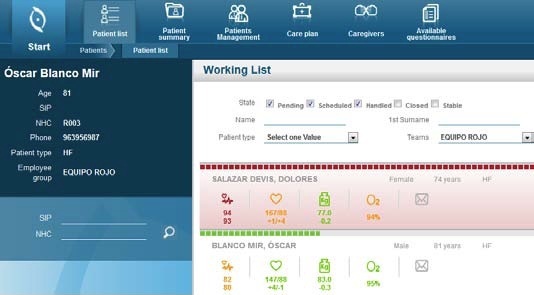
NOMAHD is an application able to stored part of this required information: workers’ personal parameters such as blood pressure, pulse and oxygen saturation. The system performs a prioritization and an intelligent management of alarms. These alarms are based on the rules and protocols accepted by health professionals and by the health system. This service will combine the information, through the prioritized alarm list, with the generation of specific summaries about the state and evolution of the person. This enables a more efficient management of events.

So far, the options managed by NOMHAD are specifically thefollowing:
  • To create a patient. The professional will fill the administrative worker data and the medical relevant data for a future evaluation. Patients will also be assigned to health professionals.
  • Reception and Display of Monitoring. The system stores the monitoring data of the person. It stores them into a database related to the personal health record in order to be used by health professionals in the future. The monitoring data are displayed in the right way, either in graphical form, numerical, image, etc. The data stored in the system are processed on arrival. A set of several rules, defined by the doctor and adapted to the personal profile, are applied. These rules allow the system to detect potential anomalies found in the data, in order to take decisions. For the definition of the rules, health professionals will have a tool to help themselves with this task.
  • To configure alerts. The system will have an alert module that, based on the monitoring data and the limits defined as optimal by a professional, will be able to detect whether the data stored are acceptable or not.
  • The possibility of assigning questionnaires. The patient mood could be extracted from these questionnaires. Health professional will choose the questionnaire and will have the possibility to personalize it depending on the needs of each worker in particular. These questionnaires will be available in the future in case the professionals want a subsequent consulting or validations.
  • Monitoring. The measurements can be obtained with usual external devices, whose information is introduced afterwards in the system or it can be used integrated elements into the system (controlled, for example, by Bluetooth and transmitting the captured data directly to the system). The design of the system can be extended to introduce new devices.
With the purpose of completing the personal data stored in NOMHAD, FASyS project proposes a connection to the current health system. This connection provides a register about the health state of the person during his lifetime, which collects data such as his diseases, surgically interventions or pains. This health system is commonly known as EHR (Electronic Health Record).
Finally, once the information has been monitored and classified, the next point is focused on the intervention. With the aim of representing prevention protocols for this intervention, workflows are developed. Given the workers singularity, the adaptation of the prevention protocols is needed for each one of them. In this way, the elimination of the occupational hazard is much more effective.
Next day we’ll focus on the architecture of the “Health Continuous Vigilance System”, as well as on the prevention protocol workflows implementation.

lunes, 18 de junio de 2012

Cloud vs. ISO20K & ISO27K …without fighting

In such so fast changing IT sector where everything happens at a frenetic pace and where legislation is going behind innovation, standards and best practices are intended to put some order and concert in the Cloud Computing operations with different success; but are they applicable?, are they useful?, are they suitable?

It is undeniable that the cloud is pulling the industry with determination as well as acceptance by users is increasing, but do ISO20K & ISO27K (and so on) standards fulfill the CloudComputing needs? Are current best practices useful to operate a Cloud?

In other words, should the Cloud adapt to legislation? or should legislation adapt and cover the new Cloud challenges?

These subjects will be discussed next Thursday, 21-june-2012, in Valencia (Spain), in the “Cloud vs. ISO20K & ISO27K …without fighting” meeting (organized by ISACA) to be celebrated at Palacio de la Colomina CEU (s/ Almudín, 1)

http://www.isacavalencia.org/index.php?option=com_content&view=article&id=346:cloud-vs-iso20k-27k-sin-llegar-a-las-manos&catid=8:isaca-valencia

viernes, 15 de junio de 2012

FASyS Project: an European R&D initiative to improve industrial workers security

Now that the FASyS Project is in its last phase and an important milestone, the prototype testing in a living lab (a real factory), is going to be started, I remind that I’ve not written about. So, “its time has come”:

FASyS is the Spanish acronym for “Fábrica Absolutamentte Segura y Saludable”, that means “Absolutely Safe and Healthy Factory”. It’s a project with 40 month duration and a budget of 23.3 M€. It is one of the 18 large Spanish strategic projects supported by the CDTI (Centre for the Development of Industrial Technology) as part of the CENIT 2009 Programme.

With the ambitious goal of improving business competitiveness through new levels of industrial safety and workplace comfort, the FASyS project aims at implementing both the excellence model for integrated occupational health and safety management in the handling, machining and assembly industries, together with a new generation of safety technologies and solutions.
The FASyS project raises the definition of an absolutely safe and healthy factory, and it is structured into 8 sub-projects that are governed by a parallel temporal sequence, in which the maturity of diverse technologies and solutions increases and evolves through the achievement of individual phases:
  • SP1 – Scenario, Requirements and Model
SP1 establish the common framework for the entire project FASyS. At SP1, the reference model factory FASyS is defined, and also the scenarios where this model will operate and the architecture that includes the supporting technologies of the implementation of this model.
The FASyS model proposes a new approach in the design, implementation, operation and maintenance of a handling and assembly factory. Facing the traditional models that focus these phases on productivity paradigms to introduce then the health and safety needs of employees, FASyS will define a new model of Sustainable Factory where the employee, his safety, health and welfare ware the central axis in the factory model.

  • SP2 – Regulations, Legal, Ethical and Social Aspects
SP2 provides the regulatory, ethical and social frameworks that contextualize the development of technologies. Since the FASyS project aims from a highly monitored scenario, it is important not to forget the ethical and social constraints which also establish a development framework for other technologies in the project. In addition, SP2 develops new business models, thus allowing new players in the system.
FASyS will provide a range of technologies and services that enable a broader vision and rich in the development of security solutions and industrial health.

  • SP3 – Sensors and Communications
SP3 is focused on providing communications technologies and the development of (bio)-sensors that will support characterization, monitoring and action services in the context of personalized prevention of FASYS strategies, in order to control not only vital sings of the employees, but as well the conditions of the workstation, including the involved machinery.
SP3 will develop a robust architecture of scalable communication; a development platform for monitoring applications on sensor networks, and it will establish efficient mechanisms for locating objects and people.

  • SP4 – Diagnostic Systems and Health Surveillance
SP4 is responsible for the development of new actuation protocols and technologies for the deployment of new personalized systems of diagnostic and continuous health surveillance. To be able of establish and maintain the better health of the employees, it is necessary to process and work with a large amount of data obtained from evaluations, monitoring, censored data, etc. data about the workstation and environment, and data related to the employee’s work profile and background (work, personal, family, health,…), and the medical history, among others.

  • SP5 – Risk Detection and Evaluation Techniques
SP5 is intended to define and design the ergonomic, psychosocial and the workplace hygiene risks prevention protocols, and the intelligent mechanisms which will allow the detection of these risks. These new protocols will be supported by a technological platform which will allow a fast and easy deployment of totally contextualized interventions to the worker conditions, the work place and the task to perform.
These contextualized interventions require a high degree of intelligence, for which this SP will focus not only in the definition of the intervention protocols, but also in the development of the semantic description of the context in which they’ll be applied.

  • SP6 – Safe Manufacturing Equipment and Processes
SP6 aims at the development of certain capacities related to machine tools which would allow the development of intelligent work safety, well-being and comfort applications and devices. SP6 bases on the need to produce a machine evolution towards an active and cooperative element within the prevention strategies, with the capability to modify its own behaviour to adapt to the environmental and user needs and work in cooperation in an intelligent manner to avoid disasters.
The elimination of risks is foreseen from the machine design. The management of this intelligence and its integration in the global framework of the system are equally parts of the activities of this SP.

  • SP7 – Risk Control Platform
SP7 provides those elements necessary to offer intelligence to the environment through the general decision-making from all the information sources generated in all the other FASyS subprojects aiming to control and act over the health and the labour risks linked to the developed tasks while they’re being identified.
The final goal of SP7 is to provide the responsible of work safety with an interface which allows him to establish the most effective means to manage and prevent the existing risks so that those lead the environmental adaptation to the detected situations.

  • SP8 – Management and Evaluation Integrated Systems
SP8 has the final goal of designing and defining all those tests which will allow the validation of the proper functionality of the technologies to develop in order to reach the concept of FASyS factory. The new optimized manufacturing processes (work place operations, interrelations, etc…) will be defined and implemented inside the FASyS model, and with the results of the tests and through the user experience obtained by living labs means, the safety and prevention systems evolution plan from the actual model towards the FASyS model will be defined.


This 8 sub-projects has been split in a huge of tasks that are been implemented in 3 phases:
  • Phase I (2009-2010 Year) Specification of the FASyS Model and associated subsystems. Ensure the viability of Technologies at subsystem level.
  • Phase II (2011 Year) Develop mechanisms to ensure proper and easy integration and interoperability of all FASyS subsystems and technologies.
  • Phase III (2012 year) Ensure interoperability and optimization in system operation.
Normal delays on the project evolution produces we are lightly behind schedule and the current forecast is to finish on February 2013.

More information about the project can be achieved in http://www.fasys.es/en/ and we’ll speak again about in next comments, focusing on the Tissat role in this project.

martes, 5 de junio de 2012

IPv6 Launch Day: 6 june 2012.

Organized by the Internet Society, and building on the successful one-day World IPv6 Day event held on 8 June 2011, World IPv6 Launch represents a major milestone in the global deployment of IPv6. As the successor to the current Internet Protocol, IPv4, IPv6 is critical to the Internet’s continued growth as a platform for innovation and economic development.
In consequence, major Internet service providers (ISPs), home networking equipment manufacturers, and web companies around the world are coming together to permanently enable IPv6 for their products and services by 6 June 2012.
World IPv6 Launch day
As everybody knows, TCP/IP (Transmission Control Protocol/Internet Protocol) is the technology that devices use to interact in Internet. IP addresses are the unique identifier that devices use to communicate to each other over the Global Internet. At the inception of the Internet, IP version 4 (IPv4) was and is currently the most widespread protocol used to communicate. By their binary nature, IP addresses are a finite resource (IPv4 assigns 32 bits for an IP address, and therefore has 232, i.e. 4 294 967 296 possible addresses) addresses. IPv4, specifically, is approaching full deployment globally. The keeper of the free address pool, the Internet Assigned Numbers Authority, (IANA), is fully depleted of IPv4 resources. Also, the Asia Pacific Regional Internet Registry, 1 of the 5 regional registries that report to IANA, is fully depleted of IPv4 resources.
Therefore, to continue the operation of the Internet, Internet Protocol version 6 (IPv6) was created.(IPv6 was developed by the Internet Engineering Task Force (IETF) to deal with this long-anticipated IPv4 address exhaustion, and is described in Internet standard document RFC 2460, published in December 1998). This address space is vast–more than IPv4 and unlikely to be depleted in the next 50 years (IPv6 uses 128-bit addresses, so it has an address space of 2128 approximately 3.4×1038). Therefore, it also eliminates the primary need for Network Address Translation (NAT), which gained widespread deployment as an effort to alleviate IPv4 address exhaustion.
However, IPv6 deployment has been slow. While deployment of IPv6 has been accelerating, especially in the Asia-Pacific region and some European countries, areas such as the Americas and Africa are comparatively lagging in deployment of IPv6: the former because so far they have enough Ipv4 addresses, the later because of the poor Internet usage percentage. In December 2010, according to wikipedia (from I get most of data of this comment), despite marking its 12th anniversary as a Standards Track protocol, IPv6 was only in its infancy in terms of general worldwide deployment.
But, in my opinion, when the American Registry for Internet Numbers, (ARIN) is almost running out of addresses and when smart mobile devices and advanced peer-to-peer application (home devices no as much because of NAT) are increasing the need of “real” IP addresses (without NAT).
DataCentres and Networks Providers wishing to grow must transition to include both IPv6 and IPv4, eventually transitioning entirely to the new protocol. However, the important fact is that IPv4 and IPv6 are not compatible.
There are several mechanims for transitioning to IPv6, since “tunneling” to proxying and address translation, but may be the most deployed is “dual stack”. The later means that any device that wishes to be “online” must be compatible with both protocols for some time to work properly. To clarify, the world network operators will be “dual stacking” these protocols for some time. This means that both IPv4 and IPv6 will concurrently run on the same wires, even though they do not interact. In fact, any modern operating system and/or browser is actually IPv6 ready today, and run both IPv4 and IPv6 simultaneous – check out of TCP/IP settings and you’ll see that you should have both types of addresses already.
While both protocols will be running together for some time, not all hardware or connection points support this concept of “dual stacking.” It is imperative to know this as a data center operator as you begin to assess either how to bring your current infrastructure online and/or design/spec future builds so that all equipment selections support both protocols
The main effect of IPv6 Launch Day is that a consortium of major players in Internet infrastructure (between them is Tissat) says parts of their infrastructure will begin supporting IPv6, the next generation of the Internet Protocol (IP) that powers the Web.

martes, 29 de mayo de 2012

"Real” Cloud Computing Services vs. “Fake” Cloud Computing Services

Some days ago (I’ve left enough days in order people that meets me wasn’t be able to find out what event was) I assisted to an event about Cloud Computing that was developed in the campus of an important Spanish university and organized by an international organization created for fostering business around Cloud Computing (let me not mention its name, because I think they don’t do their best in moderating and focusing the meeting). Most of the assistant was local entrepreneurs or technical staff. Besides, all but one of the speakers was local people, including a University chairman; in the other side, the organizer representative was foreigner (non local people) and supposed expert, or al least knower, in the subject to be treated. In that meeting I listened, and nobody contradicts or opposites them (nor the organizer, nor other speakers, nor university teachers that was present, probably because they want to be polite), some statements that I disagree (unfortunately I couldn’t, nor wished, to stay until the final open round table).

First of all, let me summarize some opinions (in fact I am not its owner, I just copied them from a lot of experts with who I share their point of view):
  • Cloud Computing is an open and evolving concept that probably will be redefined in coming years in function of:
    • the way Clients (companies, organizations or persons) use its services and demands new ones,
    • Providers imagine and develops new services
    • and, also, Technical Advances enable new ideas or services
  • Historically the use of its name, “cloud computing”, comes from:
    • the “cloud” that was used to represent the abstraction of Internet connecting everything
    • The verb “to compute” used in its utmost widest meaning, I mean, not only the calculation itself but also everything needed for the calculation: storage, communications, and so on.
  • In order to have a “reference”, the most used and accepted definition of Cloud Computing is the one of NIST that, without regarding the Service Model (IaaS, PaaS or Saas) and the Deployment Model (Private, Community, Public or Hybrid), states 5 Essential Characteristics for a CloudComputing services (see http://csrc.nist.gov/publications/nistpubs/800-145/SP800-145.pdf) that I copy below because it’s worth remembering them:
    • On-demand self-service. A consumer can unilaterally provision computing capabilities, such as server time and network storage, as needed automatically without requiring human interaction with each service provider.
    • Broad network access. Capabilities are available over the network and accessed through standard mechanisms that promote use by heterogeneous thin or thick client platforms (e.g., mobile phones, tablets, laptops, and workstations).
    • Resource pooling (multi-tenant). The provider’s computing resources are pooled to serve multiple consumers using a multi-tenant model, with different physical and virtual resources dynamically assigned and reassigned according to consumer demand. There is a sense of location independence in that the customer generally has no control or knowledge over the exact location of the provided resources but may be able to specify location at a higher level of abstraction (e.g., country, state, or datacenter). Examples of resources include storage, processing, memory, and network bandwidth.
    • Rapid elasticity. Capabilities can be elastically provisioned and released, in some cases automatically, to scale rapidly outward and inward commensurate with demand. To the consumer, the capabilities available for provisioning often appear to be unlimited and can be appropriated in any quantity at any time.
    • Measured service. Cloud systems automatically control and optimize resource use by leveraging a metering capability at some level of abstraction appropriate to the type of service (e.g., storage, processing, bandwidth, and active user accounts). Resource usage can be monitored, controlled, and reported, providing transparency for both the provider and consumer of the utilized service.
  • Computer Virtualization is a technology that enables cloud computing of processing (calculating) resources: it’s currently needed for developing a Cloud solution, but it’s only about a subset of resources (computing, but also storage and communications must be faced up, and these 2 last are not afforded by virtualization) and it’s only part of tool and features needed (for example self-service feature isn’t used to be provided by most of existing virtualization products).
  • Internet based application accessed by a browser is not necessarily a cloud computing service.

So when I earth that someone is doing Cloud Computing since firsts 2000s I think, I believe that he is wrong or he misunderstand the concept (or simply hi’s taking advantage of a buzz-world).

So when I listen to someone to state that its “vertical” application (not a generalist horizontal service as e-mail, CRM, and so on) is SaaS since 5 years ago I think he is wrong: maybe you only need a browser to use his application, maybe the service is sold in a pay-per-use basis and even maybe is on a multi-tenant platform; however a 5 year old vertical application (neither modified, nor migrated to some cloud service as the provided by RightScale, nor migrated to a PaaS, nor so) probably will not scale fast up (or down) to provides enough resources to incoming users (or when user log out).

I agree that so far it has been a purist discussion (in some way an academic point of view). However, it’s more worrying if you find out that the application you use in a pseudo-cloud-service way is hosted in a server, maybe a big server, even a mainframe, or even a clustered platform, but the application is “anchored” to a specific existent platform been not able to move to other or to increase when more compute or storage or broadband is needed.

I also agree that for most SaaS users (mainly citizens and SME) the difference is neither perceptible nor important. They only want the service, as cheaper as possible and paying for the use they do of it and they trust, or hope, the promised SLAs will be met (or not?).

So, the tradeoff is: in one hand, a Real Cloud Service Provider will probably serves you better; in the other hand, Real Could Service Providers use to be more expensive than the fake one.

In one side, a Real Cloud Service Provider will probably serves you better; of course, Real Cloud Providers have a big platform, but it is limited, and in general they overbook its capabilities, and that it is also possible they do not meet SLAs (in fact it happens seldom). In the other side, it was quite difficult you lose service for days in a Real Cloud Servicer as it seldom happens in a fake “buzz-worded” Cloud Service, losing data even, and so on.

Finally, it’s also known some important companies (RIM, Google, …) failed in delivering some of its services for a few days (by the way, let me another academic question: are they Real Cloud Service Providers?)

Therefore my question is:  is it worth paying the difference? or when?

PLEASE, LET ME KNOW YOUR OPINION ABOUT

martes, 22 de mayo de 2012

Market Analysis of Personal Cloud Services

In previous comments in this blog, some in English (“Personal Cloud, pending challenges”, “Discussion on Gartner Forecast about Personal Cloud”, and so on) and others in Spanish (“StackSync, un ejemplo español de Personal Cloud”, “Personal Cloud ¿un nuevo modelo de despliegue de Cloud Computing?”, etc.) we have already discuss about Personal Clouds. Among the current services that could be qualified as Personal Cloud, the pioneer o probably the most mature is an application that allow sharing and synchronizing data between different devices of the same person, or even from different person but always under the fine control of the owner of the information and with its permission. The main well-known paradigm and probably the reference against others are compared is DropBox. (Note, in this discussion we are to focus in DropBox similar services, and to forget other kind of Personal Cloud Services, for example Cloud Desktop that was treated by Gartner in “Personal Cloud to replace PC by 2014” as mentioned in a previous comment on 2012-mar-20).

In today comment I want analyze the market about this service, first, focusing in the main business features of this market, and after reviewing the current services and players that are competing.

The state of the market could be digested in the following points:
  • Market is still in its early stages. Although there are some long-established products and suppliers, most are still young.
  • The space is highly fragmented. Besides, all of the suppliers in this market, especially the smaller ones, are finding it challenging to clearly map out where they and their competitors play – and where they want to be.
  • There are some significant strategic uncertainties hanging over the entire Personal Cloud SaaS solutions.
  • The technology trends are difficult to read, and changing very fast.
  • Acquisitions and consolidation will probably begin to occur, since some big players are outside of the market right now.

As stated previously Dropbox is a no too big company, but it’s probably the main reference currently. Besides there already are some big companies playing in this market:
  • The just come Google Drive,
  • Microsoft SkyDrive,
  • iCloud of Apple,
known by everyone interested in this subjet. All of them (with differences, of course) are mainly cloud storage solutions, and it’s quite difficult compete with them.

However, there are other alternatives, perhaps not as well known as their large relatives, looking for some kind of specialization that open a niche market for themselves:
  • SugarSync. Dropbox’s main competitor until the arrival of Google Drive, works on both Windows and Mac, iPhone OS, Android, BlackBerry and Windows Phone. One of the main distinguishing features is that the user can simply indicate in each folder or file if he wants to upload files to the cloud and also if must synchronize all user devices or just the data at some specific.
  • Box. A very popular and widespread alternative, is remarked all the integration possibilities it offers. Having opened its API, mainly emphasizes collaboration options offered to users.
  • Cubby. Cubby, a product of LogMeIn, tries to become the perfect choice for those looking functionalities between Dropbox and SugarSync, allowing the user also to synchronize multiple computers simultaneously. Because of the API is not public, it does not integrate with other apps.
  • Insync. This product may be one of the solutions more affected by the announcement of Google Drive, because this cloud is focused on access to Google Docs from different devices.
  • Wuala. With a privacy-oriented design, the user can not even access their own files through the web, using for connection a Java web app, that assures that encryption is always processed on the device.
  • Syncplicity. Focused at business sector, provides automatic backups and is able to access multiple versions of documents, also offering the flexibility to synchronize files with different devices (Windows, Mac, Android and IOS), and other features for real-time collaboration.
  • OwnCloud. Is a flexible, open source file sync and share solution. Whether using a mobile device, a workstation, or a web client, can be synchronized with Amazon, or Google localStorage.

Most of that solutions are USA companies that are not worried, in general, to be compliant with Directive 95/46/EC of the European Parliament and related user’s privacy rights.

Besides for the success of the solution, it’s also needed to make the user feel that he’s no captive of the solution, therefore standardization and/or, at least, interoperability are needed. Besides, Public Administrations and many private companies are reluctant to store their information in the cloud, due to legal restrictions and because of the lack of security, about the property and access conditions to such information.

In summary, Personal Clouds are in their infancy, and two major problems must be solved to facilitate their massive adoption by users and companies: privacy and interoperability.

Tissat is partnering with other European companies (Canonical and Eye OS ) and R&D organizations (Universitat Rovira y Virgili, Institut Eurecom, and Ecole Polytechnique Fédérale de Lausanne) to launch the CloudSpaces project (partially funded by European Commission) that will face up to both challenges and we hope its research activities bring new ideas and approaches to solve them, and let Tissat to improve its StackSync service with even enhanced security features.