lunes, 25 de marzo de 2013

Cloud Computing Countries Ranking, or the Cloud Confusion even among market analyses (BSA vs Gartner vs IDC)

Roughly 1 month ago I read a Roel Castelein’s post about the problem of Cloud Computing in Europe . I copy the first lines of it because I think it’s a good explanation and pretty ingenious metaphor about what it is happening:
When shopping on a fruits and vegetables market, we take many things for granted; like all stall holders speak the same language, we can pay for the goods with the same currency for a fixed price by a standardized measurement and ordering what we want is straight forward. But what would happen if all these conventions were absent? Like when asking for an apple with one stall holder, we need sign language, to point out apples with a stick (sold only by crate), pay in bags of salt. His neighboring stall holder offers apples only by piece, measured by weight, and payable by copper coins, and ordered by crayon drawings. This would be confusing for the consumer, and market growth would be hindered by a lack of standardization and transparency. This is what the Cloud Services Industry resembles at the moment.
 
It’s a clear evidence of the cloud industry is still in its infancy, and that post follows analyzing the EU Commission policy based on a IDC survey (conduceted in behalf of EU Commission and that you can get it here) that I also analysed so months ago (¿Tienen futuro los servicios Cloud europeos?, ¿y los españoles? and in the post titled ”Cloud Computing and the EU Digital Agenda: A step in the right way“).
 
But the above Roel’s simile, in my opinion, also reflects what is happening in the area of Consulting companies when they analyze the Cloud market. To explain my point, let me summarize some ideas that I’ve already showed in previous posts analyzing the opinion of DC and Gartner, and contrasting them against the recent ones of BSA:
 
1) On September, the 25th, the EU Commissioner for Digital Agenda (Ms. Neelie Kroes) said “Today we launch a significant package of measures to build that trust and boost our economic future. Today we make Europe not just cloud-friendly: but cloud active. And we offer our economy a160 billion-euro boost”. And those words were based in IDC report that analyses the business barriers for adopting the Cloud in Europe: These barriers have not stopped public cloud adoption so far, but have limited the number of cloud solutions adopted.
The IDC recommendations for the most relevant policy actions (which should be included in the European Cloud Computing Strategy to create a “cloud friendly and proactive environment” in the EU and maximize the chances of achieving the benefits identified in the “Policy-driven” scenario) were:
  • Removing Regulatory Barriers
  • Building Trust in the Market
  • Protect Consumers’ Rights to Control Their Data and to Be Forgotten
  • Promoting Standardisation and Interoperability
  • Building the Business Case for Cloud Adoption
  • Contributing to the Business Case for High-speed Broadband Infrastructures
 
 
2) Besides of the IDC report, I also analyzed (just a couple of months before the IDC report) a Gartner report titled “Europe behind the US on cloud”, according to Gartner. It stated that “The opportunities for cloud computing value are valid all over the world, and the same is true for some of the risks and costs. However, some of cloud computing’s potential risks and costs – namely security, transparency and integration – which are generally applicable worldwide, take on a different meaning in Europe”. And they present the 4 main problems to justify its statement:
First, the Europe’s diverse and ever-changing data privacy regulations inhibit the movement of personal data to the cloud.
Second, the complexity of business-to-business multi-enterprise integration and processes.
Third, EU policy-making processes and practices can hinder business.
Fourth, the effect on investment of the debt crisis in the eurozone.
 
 
3) And, finally, a few days ago I read the Business Software Alliance (BSA) report about the best 24 countries prepared for the Cloud; first of all, I must be honest and recognize that BSA is not my favourite because of the way they use to get its goals, but they have a lot of media and they use to do good market analysis (disregarding the final goal of them):
 
Surprise!, the top ten that have more robust policies for business in the cloud are Japan, Australia, Germany, United States, France, Italy, UK, Korea, Spain, and Singapore. (Note at the bottom of this post you’ll find the complete ranking).
 
OK, as a Spanish technician, I’m proud to be in the ninth place, if it would be correct). Moreover, as European, I’m also happy when I see German in the 3rd place, and France in the 5th, Italy in the 6th and United Kingdom in the 7th (by thaw way, let me say it again, Spain in the 9th) … and according that study the US is behind Germany in the 4th place, and tightly, as aforesaid, followed by France, Italy and UK. According to the BSA market analyses the main cuties of EU economy seam to do, all together, the things better than others …so, what happens with the Gartner’s Analyses?.
 
First of all (disregarding the final goals of BSA, that I don’t want to analyze because probably I won’t be fair) we should to quote its words and we can summarize them in that the countries were scored, taking into account their laws and regulations for provision of cloud watching seven areas: data privacy, cyber security, cyber crime control, preservation of intellectual property, technology interoperability and legal harmonization, free trade, and infrastructure IT”. Quoting again BSA, Japan, the first country in the raking, has a comprehensive suite of modern laws that support and facilitate the digital economy and cloud computing — from comprehensive privacy legislation that avoids burdens on data transfers and data controllers to a full range of criminal and IP law protections. Further, Japan is a leader in the Japan has a comprehensive suite of modern laws that support and facilitate the digital economy and cloud computing — from comprehensive privacy legislation that avoids burdens on data transfers and data controllers to a full range of criminal and IP law protections”.
 
Therefore, BSA proposes seven policies that Governments should strengthen to expand economic opportunities in the cloud computing solutions, and in fact its analysis is based in the following that “seven policy categories that measure the countries’ preparedness to support the growth of cloud computing”:
1 – Protecting the privacy of users by allowing the free flow of information and commerce.
2 – Promote advanced cybersecurity practices without requiring the use of specific technologies.
3 – Fighting cybercrime with clear measures and actions against the perpetrators.
4 – Provide protection strengthened against the misappropriation and breach of cloud technologies.
5 – Encourage openness and interoperability between cloud providers.
6 – To promote free trade, reducing barriers and eliminate preferences for certain products or companies.
7 – Provide incentives for private sector to invest in broadband infrastructure and promote digital inclusion.


Well, in you’ve compared what any report say, you probably understand my point: there’s cloud confusion even among the Consulting companies.
 
About that kind of governmental policies, let me state my very particular opinion: disregarding what other important laws (as the ones stated in the BSA report or in the European Digital Agenda recommendations) and governmental policies (also analyzed by the great Consulting companies), the US Government with its “First Cloud” policy and the UK Convergent with its “UK Cloud Store” that pursue to foster the Cloud market in the US or UK Administration organisms are quite incentive and will help to foster the private Cloud market too. Of course the private initiative is important, but some kind of public incentive will accelerate it specially in Europe (where public sector influence in IT business is more important than in USA. ); indeed, the US government is practising that policy, may be for different reasons, or for that ones and others.
 
 
Let me finalize quoting the whole ranking and the scores of 24 countries surveyed by BSA:
01 – Japan – 83.3
02 – Australia – 79 2
03 – Germany – 79.0
04 – United States – 78.6
05 – France – 78.4
06 – Italy – 76.6
07 – United Kingdom – 76.6
08 – Korea – 76.0
09 – Spain – 73.9
10 – Singapore – 72.2
11 – Poland – 70.7
12 – Canada – 70.4
13 – Malaysia – 59.2
14 – Mexico – 56.4
15 – Argentina – 55.0
16 – Russia-52.3
17 – Turkey – 52.1
18 – South Africa – 50.4
19 – India – 50.0
20 – Indonesia – 49.7
21 – China – 47.5
22 – Thailand – 42.6
23 – Vietnam – 39.5
24 – Brazil- 35.1
 
Here you can find the full BSA report

martes, 19 de marzo de 2013

Interoute y Tissat refuerzan su acuerdo de colaboración para ofrecer servicios de Consultoría TIC

Interoute colabora con su amplia oferta de infraestructura de comunicaciones y sus Centros de Datos Europeos y Tissat aportará su experiencia en soluciones en DRP (Recuperación de Desastres) y continuidad de negocio, Cloud, Backup y Escritorio Virtual as a Service, entre otros servicios

 
Interoute, el operador con la mayor plataforma de servicios cloud de Europa, ha firmado un acuerdo de colaboración y apoyo mutuo con Tissat, propietaria del centro de datos más avanzado de Europa denominado Walhalla, para impulsar los servicios de Consultoría TIC a nivel internacional.
 
En virtud de este acuerdo, Tissat aportará su experiencia en proyectos de consultoría TIC especialmente en soluciones de Recuperación de la información ante Desastres y Continuidad de Negocio, además de sus soluciones cloud IaaS Storage as a Service, Backup as a Service y Escritorio Virtual as a Service, que completan la oferta de IaaS de Interoute con su servicio en sus Centro de Datos distribuidos por Europa. Además, Tissat aporta sus soluciones verticales de Estrategia Social Media, Social CRM, Social Buzz Monitoring, Social E-Commerce, Colaborative – Crowd-Computing, Gestión de Flotas, Cuadro de Mandos, Movilidad Urbana y Administración Electrónica.
 
Por su parte, Interoute colabora con su amplia oferta de infraestructura de comunicaciones y sus diferentes Centros de Datos Europeos, entre los que figuran los propios de Tissat, ya que ambas empresas mantienen un acuerdo de colaboración desde enero de 2012, por el que Tissat se integra en la red paneuropea del operador, permitiendo a ambas empresas ofrecer servicios de manera conjunta en esta red de Centros de Datos.
 
Walhalla es el único centro de datos español y uno de los principales europeos que puede ofrecer servicios de alojamiento de datos y aplicaciones a las empresas con las máximas garantías de seguridad y confidencialidad de los datos allí alojados, así como disponibilidad y continuidad del servicio. Dispone de capacidad para guardar todos los datos de empresas e instituciones con un volumen de información importante, desde administraciones públicas a grandes multinacionales.
 
En palabras de Carmen García, Directora de Tissat Madrid, “es un placer para nosotros ampliar el objeto de colaboración del acuerdo que ya manteníamos con una empresa del prestigio de Interoute, aportando nuevas soluciones y servicios, ya que ambas empresas podemos, desde la colaboración, revalorizar y diversificar nuestra oferta y ampliar el ámbito de nuestras colaboraciones”.
 
Diego Matas, director general de Interoute Iberia, ha comentado: “Tissat aporta un valor añadido a nuestra oferta de soluciones y estamos satisfechos de reforzar nuestro acuerdo y seguir colaborando juntos para satisfacer la demanda de nuestros clientes”.
 
 
Nota:
Interoute es la compañía propietaria y operadora de la red privada de voz y datos más avanzada y mejor conectada de Europa, con más de 60.000 Km. de fibra iluminada, 9 centros de datos integrados en su infraestructura, 32 centros especializados de alojamiento compartido de equipos (co-location) integrados en la red y conexiones con 140 centros de datos gestionados por terceros en toda Europa. Su plataforma Unified ICT da servicio a compañías internacionales de diversos sectores, desde los antiguos monopolios de telecomunicaciones de Europa y los principales operadores de América del Norte, Este y Sur de Asia a gobiernos y universidades. Estas organizaciones encuentran en Interoute al socio idóneo para gestionar sus soluciones de telecomunicaciones y el desarrollo de servicios de Valor Añadido.
Su estrategia Unified ICT ha demostrado ser muy atractiva para organizaciones que buscan una plataforma escalable, segura y sin restricciones para alojar sus aplicaciones de voz, vídeo, informática y datos, así como para los proveedores de servicios que necesitan alta capacidad internacional para tránsito de datos e infraestructura. Con operaciones en los principales países europeos, Norteamérica y Dubái, Interoute también posee y opera redes metropolitanas en los principales centros de negocios de Europa.

martes, 5 de marzo de 2013

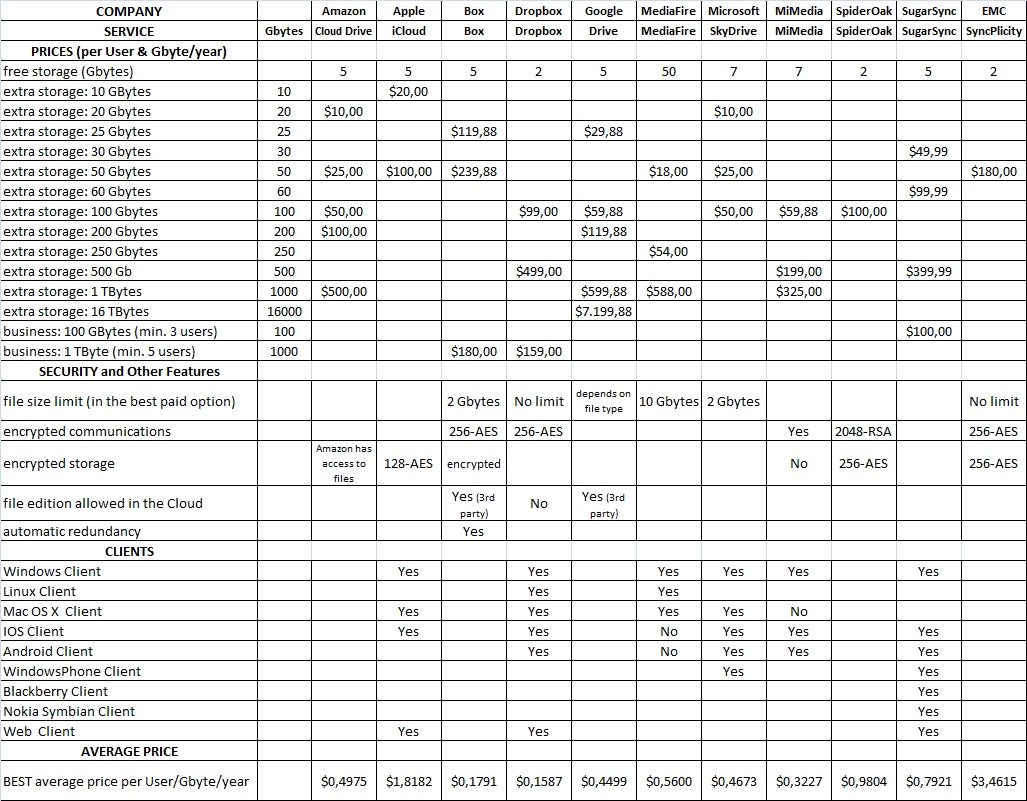
Personal Cloud Services Comparison

Recently (on 12 February 2013) Gartner has published its “MarketScope for Enterprise File Synchronization and Sharing”. Quoting to Gartner, “Enterprise file synchronization and sharing (EFSS) offerings enable productivity and collaboration for mobile workers who use multiple devices, such as smartphones and media tablets, in addition to PCs. Organizations must deploy EFSS services to secure enterprise information assets. Failure to provide these capabilities will subject organizations to information leakage threats caused by users who move data through uncontrolled personal cloud services”.
 
When I read this article, I recognize the generalization (as the same Gartner states in its report) of the concept of “Personal Cloud” (going, and widening, from the personal needs to the workers and company needs: the EFSS, subject on which I come back in the future),  about what I spoke several times in this blog last year (e.g. ”Market Analysis of Personal Cloud Services”, “Personal Cloud, pending challenges”, “Discussion on Gartner Forecast about Personal Cloud”, or “StackSync“).
 
As the name of one of those post announces, I‘ve already made a short analysis of the market at the date of the study (may 2012) and even shorter review of some products available in that moment: Dropbox, Google Drive (it that date just appeared), Microsoft SkyDrive, iCloud of Apple, SugarSync, Box, Cubby, Cubby, Insync, Wuala, Syncplicity (now acquired by EMC) and OwnCloud.
 
So, by the end of that year (2012) I decided to go more deeply into that study and I gathered when possible more data to widen the study scope. It was quite difficult, in short, because the market is still immature, as I’ve already said in some old post. About the market, in general, I keep my main old conclusions and expand them with the following ones:
  1. The market is highly fragmented
  2. A lot of small suppliers
  3. Great dynamism
  4. Mergers, acquisitions and consolidation will become common, since some big players are still outside of the market right now.
  5. It’s quite difficult to compare prices because of:
    • Some provider limit the files size (even depending in the file type).
    • Other ones limit the number of transactions (or bill for them).
    • Other ones limit the downloading traffic (or bill for them).
    • Others limit the number of User’s devices to synchronize.
    • In general the billing policies are pretty disparate: from flat rate to billing for number of users, per space quota, per downloads, per a combination of two o more of them, and so on.
    • etc.
  6. Very different technologic performances, as well as continuous improvements (several at the year) make difficult to compare vendors or providers based on their current features:
    • Available clients and supported devices
    • Redundancy and number of copies of the stored information
    • Security in communication
    • Security in stored information
    • Laws and regulation (specially about privacy) accomplishment
    • Service and support are highly variable from provider to provider, so it isn’t almost impossible to compare them.

As just stated it is not easy to compare services but to be hones it’s still more difficult because in most the cases not all the needed information is publicly available in the web site of companies: so, if you aren’t Gartner, you have ask that information or to sign for a free trial (where the performances are not the same of the real services), and so on. In this way I must mention too, that it was helpful the work made by other people, since I found related reports with valuable information. So when I compare all the information I decided not publicize because there are a lot of blank cell: comparison is not possible. However, after reading the aforementioned Gartner report, where they left out a lot of important players (for good and explained reasons) as Dropbox, Apple (iCloud), Microsoft (SkyDrive) and Google (GDrive), ownCloud and others, I decided to publish my results because some of them are in my table.
 
Prior to show my comparison table, please let me see it again:
  1. When you see a blank cell in my comparison table just implies that I’VE NOT BE ABLE to get the information.
  2. And the comparison took me a couple of months (I do it in my free time) so I compare services at different dates.
  3. And it was finished in the first half of the last December (so these results today could, and probably will, be different)
  4. Frankly, I also must state that I use several reports that I found about this subject (introducing a wider time gap).
  5. Note: I’ve got the time and the Gartner permission; in future post I’ll summarize the Gartner’s “MarketScope for Enterprise File Synchronization and Sharing” report.

Next table summarizes my own comparison results:

Personal Cloud Services Comparison.large

miércoles, 27 de febrero de 2013

Eucalyptus corrections to my post “Open IaaS Platform Comparison (2nd part)”

 
Recently I’ve received an e-mail about this post titled “Open IaaS Platform Comparison (2nd part)” from Mr. Marten Mickos, CEO of Eucalyptus Systems, clarifying or amending some of my comments that I should publish. I quote its words:
 
Comments from Eucalyptus:
  • We agree that the API abstractions of Amazon Web Services have become a de facto standard in the cloud world. More than that, the AWS ecosystem is the most important driving force in software development for cloud today.
  • Eucalyptus has the most complete AWS compatibility and is the only vendor to work in partnership with Amazon Web Services on API compatibility.
  • Eucalyptus has a range of advanced storage services including Walrus (compatible with S3), EBS and JBOD.
  • The Network World comparison is radically outdated and partly incorrect.
  • It is based on Eucalyptus 2.0 which was shipped in 2010. Since then, Eucalyptus has gone through three major product generations – 3.0, 3.1 and now 3.2. – and added significant functionality such as HA, IAM, a new user console, etc.
  • Generally, Eucalyptus stands out in a comparison with the other 3 open source cloud platforms as the one that is AWS API compatible and the one that has taken productization the farthest. Therefore, it is the fastest path to a functioning hybrid cloud.
  •  
      
And my own comments about Eucalyptus clarifications or amendments are:
  • I’ve let out OpenNebula in this second part of comparison (but not in the first one, referred also in the blog) only because I use (that I clearly stated that it was copied from “Network World”) a table done by other (I mentioned Mr. Vadim Truksha) that unfortunately does not include OpenNebula.
  • The same reason was the cause for referring Eucalyptus 2.0.3 and no to the current version. Actually I noted in the posted that the comparison table was done 7 months ago roughly.
  • About some of their words about AWS I fully agree too. In fact in my aforesaid post I argue the same ideas but in other words:
    • AWS – holds 70 percent of the IaaS; by the way we should be honest and thank Amazon for popularizing IaaS and making it affordable, accessible, and broadly relevant to the current IT market, and for keep innovating about.
    • AWS APIs are becoming, in some way, a “de facto” standard since other vendors declare to be compatible with.
    • Besides, I also said that Eucalyptus signed an agreement with Amazon in 2012, that it also made it easier for Eucalyptus to bill their product as the natural partner to Amazon’s offerings

Of course, I’ve not doubts about Mr. Mickos corrections about Eucalyptus’ product, so I beg its pardon about the possible inconvenient and I’m publishing this note in different ways and media to solve the problem.
 
Finally I want to thanks Mr. Mickos a lot for spending its time reading my blog and sending its clarifying words, given me the opportunity of correcting and improving my blog.

jueves, 21 de febrero de 2013

Open IaaS Platform Comparison (2nd part)

This post is the third of a series that I started in 24/01/2013. In that post I stated that the use of open and “interoperable” Cloud Platform is a key feature (even a must) to ask your Cloud Service Provider for, because it prevents (or, at least, makes difficult) from falling captive of a vendor (vendor lock-in), i.e. you’ll be able to easily move your applications from one an IaaS provider to another interoperable one, without having to alter your own Cloud designed applications and the services they offer. You can even download a copy of open Platform to run inside your own data center as well, which (in principle) makes it feasible to move computing jobs from a private data center to commercial clouds and back again, at will: Moreover, with that approach, hybrid cloud construction becomes easier.
 
In the second post of this series, I revise first the standardization processes around Cloud; second, we found how Amazon (given that according to some statistics, Amazon Web Services – AWS – holds 70 percent of the IaaS) is achieving that its service APIs are becoming, in some way, a “de facto” standard since other vendors declare to be compatible with: once again let me say that we should be honest and thank Amazon for popularizing IaaS and making it affordable, accessible, and broadly relevant to the current IT market, and besides for keeping innovating about, however, we must remind that APIs specification is not open but proprietary, and Amazon could change whenever it wants by itself. So, currently and almost sure in the future you are captive on Amazon if your application is developed on its APIs. So, that post finalizes analyzing several open source cloud platform. OpenStack, Eucalyptus, OpenNebula and CloudStack from two different points of view:
  • its community support, and main service coverage:
  • its relationship with Amazon, i.e., their support of Amazon’s APIs

And my conclusions were (and are) that:
  • Eucalyptus, OpenNebula and CloudStack have embraced Amazon Web Services (AWS) APIs to have compatibility with AWS’s application programming interfaces. OpenStack, while so far supporting AWS in its open source code, and has taken a much different approach and is attempting to position itself as an open-source alternative to AWS.
  • All of them, also supports the OCCI API, or are in its way of do it, enabling (or easing) the future cross interoperability.
  • Besides, while Eucalyptus, CloudStack and OpenNebula are open product offered and supported by a company (besides of a community), OpenStack is an full open source code that vendors or end users can adopt themselves to manage a cloud.
  • Finally (referring to the one analyzed in this post) all of them offer or enable to build services similar to the Amazon EC2, but OpenStack is the only one of them that span the bare compute service, and offers scalable object storage for petabytes of accessible data as the ones of Amazon’s S3 Services, besides of traditional block storage.

To conclude that comparison, today we are going to analyze other more technical subjects, and fortunately Vadim Truksha (in Network World) has already done that work 7 months ago roughly, so in spite of Cloud area is changing quickly I think is accurate enough, and I showed it in the above table.

But before show it, let me advice in advance a couple of points:
  • First, the comparison only is about one main resource: compute, included of course the block storage that this kind of resources needs as well as basic communications needs; it doesn’t compare other important resources as stand-alone storage, usually needed very cheap, where the best solution is “block storage”, and advanced communications features: I mean the related ones with Software Defined networking (SDN) that let align, in real-time, communications with the fast changing needs of application, virtual machines (VM) movements, and so on.
  • For simplification reason, in the previous posts I do not analyze the virtualization market leader VmWare, that is trying to become a big Cloud player too, but the current VmWare’s Cloud offering is restricted to the VmWare ecosystem, so it’s a proprietary solution and the problem is the same. However, as a VM management platform it’s unquestionably the best, if you can afford its costs. In future post (with enough time for that) I’ll analyze this subject deeper. And this note, it’s because in the table appears VmWare’s vCloud Director 1.5

So here it’s the comparison table:


Some Cloud Computing Platforms Comparison
 
 
NOTE added on 2013/feb/27. Recently I’ve received an e-mail about this post from Mr. Marten Mickos, CEO of Eucalyptus Systems, clarifying or amending some of my comments. I quote its words:
Comments from Eucalyptus:
  • We agree that the API abstractions of Amazon Web Services have become a de facto standard in the cloud world. More than that, the AWS ecosystem is the most important driving force in software development for cloud today.
  • Eucalyptus has the most complete AWS compatibility and is the only vendor to work in partnership with Amazon Web Services on API compatibility.
  • Eucalyptus has a range of advanced storage services including Walrus (compatible with S3), EBS and JBOD.
  • The Network World comparison is radically outdated and partly incorrect.
  • It is based on Eucalyptus 2.0 which was shipped in 2010. Since then, Eucalyptus has gone through three major product generations – 3.0, 3.1 and now 3.2. – and added significant functionality such as HA, IAM, a new user console, etc.
  • Generally, Eucalyptus stands out in a comparison with the other 3 open source cloud platforms as the one that is AWS API compatible and the one that has taken productization the farthest. Therefore, it is the fastest path to a functioning hybrid cloud.
And my own comments about Eucalyptus clarifications or amendments are:
  • I’ve let out OpenNebula in this second part of comparison (but not in the first one, referred also in the blog) only because I use (that I clearly stated that it was copied from “Network World”) a table done by other (I mentioned Mr. Vadim Truksha) that unfortunately does not include OpenNebula.
  • The same reason was the cause for referring Eucalyptus 2.0.3 and no to the current version. Actually I noted in the posted that the comparison table was done 7 months ago roughly.
  • About some of their words about AWS I fully agree too. In fact in my aforesaid post I argue the same ideas but in other words:
      • AWS – holds 70 percent of the IaaS; by the way we should be honest and thank Amazon for popularizing IaaS and making it affordable, accessible, and broadly relevant to the current IT market, and for keep innovating about.
      • AWS APIs are becoming, in some way, a “de facto” standard since other vendors declare to be compatible with.
      • Besides, I also said that Eucalyptus signed an agreement with Amazon in 2012, that it also made it easier for Eucalyptus to bill their product as the natural partner to Amazon’s offerings
Of course, I’ve not doubts about Mr. Mickos corrections about Eucalyptus’ product, so I beg its pardon about the possible inconvenient and I’m publishing this note in different ways and media to solve the problem.


miércoles, 6 de febrero de 2013

TISSAT’s Walhalla is the first Data Center awarded with the AENOR’s Data Centres Energetic Sustainability Certification


TISSAT is proud to announce that Walhalla, its Data Center located in Castellón (Spain) and Tier IV certified by The Uptime Institute, just obtained the Energy Sustainability Certification issued by AENOR.

AENOR is the Spanish Association for Standardization and Certification, that was founded in 1986, and is working in more than 60 countries, been among the 10 most important certification organizations in the world, and contributing to improving the quality and competitiveness of companies, their products and services.

Besides, Walhalla becomes the first DataCenter in the world awarded with this AENOR’s ‘EA 0044’ certification, that accredits that Data Centres accomplishes with the established energy audits, as well as energy and carbon footprint management systems, contributing to mitigate climate change.

According to this EA 0044 Technical Specification, AENOR certifies that:

  • TISSAT has realized an energy audit of Walhalla according to UNE 216501,
  • the results and improvement proposals resulting form that audit have been included in the TISSAT’s ISO-50001:2011 certified EMS (Energy Management System),
  • and that carbon footprint has been calculated accomplishing the ISO 14064-1.

The result of all this certifies the Energetic Sustainability of TISSAT’s Data Centers, placed in Castellon and Valencia, a logical corollary of our continuous R&D and innovation processes in the Green Data Center area.
In the words of Ms. Carmen Garcia, TISSAT Commercial Director, “we are proud to be awarded with this AENOR certification, not only for been the fist in get it, but also because we deeply believe that our DataCenters more than fulfil the established in EA 0044 since it is a voluntary certification to which we freely underwent”.